Tuesday, October 31, 2006

On Choosing a College

A student asks me about how to choose a college:

Hi Dr. Mankiw,

I'm a high school senior from Montclair, NJ, an avid reader of your blog (and textbook), and generally, a big fan of economics. I'm right in the middle of the college application process, and I was wondering whether you might be able to speak to the importance of getting an undergraduate degree in economics from a school with a top-notch economics program. Does the prestige of the program really filter down into the undergraduate education? Obviously, it matters a great deal for PhD programs,but would I be missing out, for example, if I chose Yale or Amherst, schools with strong but not fantastic economics programs, over a place like Harvard, MIT or Chicago? I mean,from a strictly "undergraduate economics education" standpoint, all other factors aside.

Thank you so much for all the help--I really consider you one of my most important intellectual influences.

[name withheld]

Economics departments are ranked based mostly on their research output, and teaching quality is not very correlated with research. Indeed, it is not even clear to me whether the correlation across economists in teaching ability and research output is positive or negative. On the one hand, productive researchers are more talented overall than nonproductive researchers, and that talent spills over to other activities, including teaching. On the other hand, to the extent that professors are focused on research, that can take time away from teaching. So don't expect to get much better teaching at higher-ranked schools than lower-ranked one.

The most important choice a high-school senior faces when choosing where to be an undergrad is between research-oriented universities and teaching-oriented colleges. If you go to a place like Harvard or Princeton, you get a famous faculty. But the first priority of that faculty is their own research and writing, and they are more likely to shower attention on grad students than undergrads. If you go to a place like Amherst, Swarthmore, or Williams, you get a faculty whose first priority is undergraduate teaching. But you do not have a menu of graduate courses to sample from, and you do not have as vibrant a research atmosphere to experience.

Having attended a small high school, I enjoyed being at a relatively large research university (Princeton) as an undergraduate. Given the career path I followed, that was the right choice. For someone who wants to consider a research career, being at a top research school conveys significant benefits: You get to know more active researchers early on, and you can attend a large array of research seminars. But those opportunities are not relevant for 90 percent of students at these schools, who will not go on to become PhD econonerds but will instead become doctors, lawyers, corporate executives, and so on. For those students, the choice of research university over teaching college is a closer call. I would still vote for the larger places like Harvard and Princeton, because they offer a more diverse range of activities and courses, but I would not argue too vehemently against smaller, more student-friendly colleges.

Larry Summers in the Pigou Club

I ran into Larry Summers at a party recently, and he asked to be inducted into the Pigou Club.

Larry reminded me of an article of his in the November 30, 1987 issue of The New Republic, called "A Few Good Taxes," in which he wrote:

Raising gasoline taxes would encourage energy conservation....It would also force motorists to pay more of the congestion, maintainance, and accident costs they impose by driving.
Welcome to the Club, Larry. Your secret decoder ring is in the mail.

On a related matter, membership in our facebook chapter is now up to 369.

Philanthropy and the Rich

The Bank of America reports on charitable giving among high-wealth individuals.

When asked how their giving would respond to a repeal of the estate tax, 5.5 percent say it would decrease, and 29.5 percent say it would increase. (See Figure 21.) This result is inconsistent with the conventional wisdom (as expressed in this CBO study, for instance) that estate-tax repeal would discourage philanthropy.

Either the conventional wisdom is wrong, or it is a bad idea to ask people how they would respond to hypothetical situations, or maybe both.

Better than a Nobel


The Independent reports:
The Governor of the Bank of England, Mervyn King, has announced that a portrait of Adam Smith will feature on a redesigned £20 banknote, to come into circulation next year.
The news comes under this headline:
The Big Question: Who was Adam Smith, and does he deserve to be on our banknotes?
Thanks to rgemonitor for the image.

Monday, October 30, 2006

2006 = 1958?

Harvard historian Niall Ferguson says this year's politics looks a lot like the politics of 1958, when the Republicans lost 48 House seats during Dwight Eisenhower's second term:

The parallel is especially intriguing because it was a combination of security concerns and economic woes that did the damage then. There had been a severe recession in the winter of 1957-58. But it was foreign policy that was on many people's minds. The previous year, the Soviets had successfully launched their Sputnik satellite, causing consternation among Americans, who had assumed their country had a built-in technological advantage in both the Cold War and the space race. Civil war was raging in Cuba; Fidel Castro was just a few months from victory. And in July, a coup d'etat had overthrown King Faisal II of — guess where? — Iraq, the prelude to the Baathist takeover of power in that country in 1963. American troops had been dispatched to Lebanon in response.

Ring any bells?

What's more, as happened in 1958, the combination of foreign policy setbacks and economic disappointments could set the stage not merely for Democratic gains at the midterms but for a Democratic victory in the presidential election two years down the line. Intriguingly, there is already a John F. Kennedy figure on the scene who, he recently admitted, has "thought about the possibility" of a bid for the White House. Youthful, charismatic and the personification of the American dream, Barack Obama, the junior senator from Illinois, has been this autumn's media sensation, his face on every talk show, his name in every column, his book rivaling Woodward's in the charts.

You think the U.S. is not ready for a black president? Well, back in 1958 you'd probably have said the same about an Irish Catholic.

Motherhood and Labor Supply

A new CBO study reports:
having a first child younger than one year old reduces female employment by 26.3 percentage points.
The study appears to do a good job of identifying exogenous fertility differences by comparing women who tried to conceive and succeeded with those who tried to conceive and failed.

A Freak Success

David Warsh tries to figure out why so many people are reading Steve Levitt.

Good Teachers

New research by Florian Hoffmann and Philip Oreopoulos (free link) tells us how to judge teaching ability:
subjective teacher evaluations perform well in reflecting an instructor's influence on students while objective characteristics such as rank and salary do not. Whether an instructor teaches full-time or part-time, does research, has tenure, or is highly paid has no influence on a college student's grade, likelihood of dropping a course or taking more subsequent courses in the same subject. However, replacing one instructor with another ranked one standard deviation higher in perceived effectiveness increases average grades by 0.5 percentage points, decreases the likelihood of dropping a class by 1.3 percentage points and increases in the number of same-subject courses taken in second and third year by about 4 percent.
If universities like Harvard take this research seriously when making promotion decisions, they will give less weight to research and more to student evaluations than they have historically.

The membership drive continues

The Princeton Alumni Weekly reports that George Schultz and Tony Lake have joined the Pigou Club:

While the initiative — which was co-chaired by former secretary of state George Shultz ’42 and former national Security Adviser Anthony Lake — is explicitly bipartisan, it challenges many aspects of the Bush administration’s national security approach....To promote energy independence, they call for a national gas tax that would start at 50 cents per gallon and increase by 20 cents each year for the next 10 years.
Here is the full report.

Today's Washington Post reports that economist Nicholas Stern is likely to join as well, but for somewhat different reasons:

Unchecked global warming will devastate the world economy on the scale of the world wars and the Great Depression, a major British report said Monday....

The author of the British report, Sir Nicholas Stern, a senior government economist, said that acting now to cut greenhouse gas emissions would cost about 1 percent of global GDP each year.

"The evidence shows that ignoring climate change will eventually damage economic growth," said Stern's 700-page report, an effort to quantify the economic cost of climate change.

Here is the Stern report.

Meanwhile, I am pleased to note that the Club's facebook chapter has jumped in membership from 73 yesterday to 219 today. We are still taking new members.

Government is too big, says the public

CNN reports:

Queried about their views on the role of government, 54 percent of the 1,013 adults polled said they thought it was trying to do too many things that should be left to individuals and businesses. Only 37 percent said they thought the government should do more to solve the country's problems.
And that's why Speaker Pelosi's first priority will be to shrink the size and scope of government.

Thanks to Arnold Kling for the pointer.

Sunday, October 29, 2006

Larry Summers, Columnist

Larry Summers has published his first piece as a columnist for the Financial Times.

How to join the Pigou Club


Kevin Burke, a student at the University of Pennsylvania, has opened a facebook arm of the Pigou Club. The group now has 73 members. Anyone registered in facebook is free to join.

One member posted a link to the above graphic from Foreign Policy. For previous Pigou Club posts, click here and here.

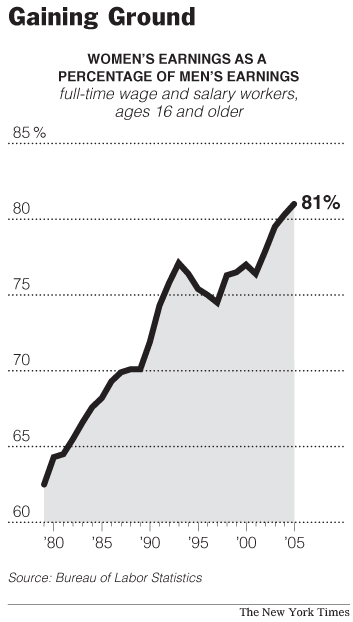
Women are catching up

The graph is from today's NY Times.

It's odd how the progress stalled from 1993 to 2001. The Clinton folk, who are usually eager to take credit for the economic developments of this period, will probably take a pass on this one.

Landes on Family Businesses

Today's NY Times reviews the new book by Harvard economic historian David Landes, titled Dynasties: Fortunes and Misfortunes of the World’s Great Family Businesses. A tidbit from the review:
Landes also wants to make a larger point, which is that the business-school mythos of the “professional manager” has led to a persistent underestimation of the importance of family firms. Fully a third of Fortune 500 companies can properly be characterized as family businesses, and on average they outperform the “professionally managed” firm by a surprisingly large margin.
I wonder how this affects David's view of the estate tax.

Saturday, October 28, 2006

So what else is new?

The Washington Post reports:
GAO Chief Warns Economic Disaster Looms
Click here for the solution.

My Politics

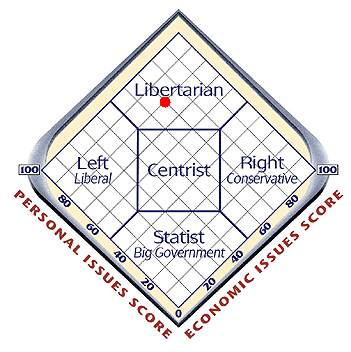
A comment on a previous post asks me whether I am a libertarian. I am, according to the world's smallest political quiz. See the red dot above--that's me.

Friday, October 27, 2006

Romer on Prop 87

Paul Romer has a nice ec10-level discussion of California's Prop 87.

Crook on Libertarians

Clive Crook explains why libertarians are lonely:
Today's main political battle is between those who want to run the economy from Washington and those who want to dictate the country's morals from Washington. (George Bush's Republican Party apparently wants to do both.) And we libertarians should not delude ourselves: If this is true, it is not because politics is letting people down but because most Americans feel comfortable in one or the other of those camps.
Crook is right that we get the kind of government we want. If libertarians want to win the battle of Washington, rather than simply airing their ideas to one another at Ayn Rand conventions, they have to make their point of view more palatable to the median voter. A politically successful libertarianism would have to be moderate and pragmatic.

Thursday, October 26, 2006

Making Life More Fair

Reported by ScrappleFace:

Dem Bill Would Force Obama to Share Charisma

Sen. Barack Obama, the presumptive 2008 Democrat presidential nominee, came under attack today from his own party when Democrats in the Senate introduced a bill that would force him to share his abundant charisma with his colleagues.

“Democrats never like to see an uneven distribution of the good things of life,” said one senate aide who helped to write the legislation. “ Sen. Obama has more than his fair share of charisma, while so many senate Democrats go without. It’s not right for so much charm and personality to be in the hands of so few.”

Under the terms of the measure, Sen. Obama’s charisma would be redistributed “to each Democrat senator according to his need.”

Reminds me of the classic Kurt Vonnegut story Harrison Bergeron.

The Return to Human Capital

Today's Washington Post reports:

How much is a bachelor's degree worth? About $23,000 a year, the government said in a report released Thursday.

That is the average gap in earnings between adults with bachelor's degrees and those with high school diplomas, according to data from the Census Bureau. College graduates made an average of $51,554 in 2004, the most recent figures available, compared with $28,645 for adults with a high school diploma....

The income gap narrowed slightly from five years earlier, when college graduates made nearly twice as much as high school graduates.

The last sentence caught my eye. It appears that the return to human capital, which increased so much over the past three decades, is now leveling off.

Alternatives to the Pigou Club

Today’s Wall Street Journal prints various letters in response to my oped on gas taxes. Rather than responding to to the specific points, or to all the comments posted on this blog, let me try to spell out more generally the alternatives from which we must choose.

Members of the Pigou Club favor higher Pigovian taxes in order to remedy externalities such as pollution and congestion while raising government revenue. If you aren’t a member of the Pigou Club, you most likely fit into one of these four categories.

1. You deny the existence of these externalities as a type of market failure. Perhaps you think you live in a Coasian fantasy world where people bargain without transaction costs to reach efficient allocations. (Note: I am not suggesting that Coase himself thought we lived in such a world—he considered it only a useful thought experiment.)

2. You recognize the externalities but you don’t think the government should try to respond to them. You are such a believer in small government that you are willing to live with inferior economic outcomes, such as pollution and congestion.

3. You recognize the externalities, think the government should try to correct them, but think the current low taxes we put on gasoline are sufficient. In this case, you have weighed and rejected the evidence, such as that of Parry and Small, that higher Pigovian would be optimal. (Parry and Small calculate an optimal tax of $1.01 for the United States in today's dollars. After my proposed phase-in of a $1 hike, the U.S. tax would be $1.40. Assuming 10 years of 3 percent inflation, the tax in real terms would approach almost exactly what Parry and Small recommend. By the way, the published version of Parry and Small was in the American Economic Review, September 2005.)

4. You recognize the externalities but think the government should try to correct the market failure through regulations (such as CAFE standards) or through market-based solutions that do not raise government revenue (such as cap-and-trade systems). Perhaps you are concerned that government would waste the extra revenue on useless government programs.

Let me respond to group 4, because my guess is that this is the largest group of antipigovians.

The reason I am less concerned that the extra revenue will be spent is that it already has been spent. The federal government has promised benefits to the elderly far in excess of what it can pay. At some point the nation will have to reckon with the looming fiscal gap. The most likely political compromise will involve higher tax revenue. We should, therefore, be ready to increase revenue in a way that does the least damage—or, better yet, the most good. If not Pigovian taxes, then other taxes will be increased.

An optimistic libertarian might hope that we can deal with the looming fiscal gap without raising the ratio of taxes to GDP above its current level. I wish I could believe that this were possible. In a previous oped, I advocated increasing, slowly but substantially, the age of eligibility for Social Security and Medicare. But even if we could scale back government spending in such a radical way, Pigovian taxes would not lose their appeal. Let’s use the extra revenue from Pigovian taxes to reduce distortionary taxes, such as income taxes. Politically unrealistic, you say? Surely, if a future government were so libertarian as to manage a radical reduction in entitlement promises to the elderly, it would have no trouble delivering equally radical cuts in income taxes. In fact, the tax cuts would be the easy part of the package.

Update: Some comments suggested new categories of nonpigovians, and some suggested the categories I described were strawmen. To be clear, my goal was to categorize, as logically as possible, the various points of view. Let me try to put the issue in terms of a flow chart.

Question: Do you believe consumption of gasoline is free of negative externalities leading to market inefficiency?

If YES, you are part of group 1.
If NO, continue.

Question: Do you believe that public policy should ignore these externalities?

If YES, you are part of group 2.
If NO, continue.

Question: Do you believe the current tax on gasoline sufficiently internalizes the negative externalities?

If YES, you are part of group 3.
If NO, continue.

Question: Do you believe the best remedy for the remaining externalities is a regulatory system rather than a higher tax?

If YES, you are part of group 4.
If NO, you are a member of the Pigou Club.

Wednesday, October 25, 2006

Rich vs Very Rich

Matt Miller has a hypothesis that might explain why so many professors I know are miffed about widening income inequality:

Here's my outlandish theory: that economic resentment at the bottom of the top 1 percent of America's income distribution is the new wild card in public life....

Lower uppers are professionals who by dint of schooling, hard work and luck are living better than 99 percent of the humans who have ever walked the planet. They're also people who can't help but notice how many folks with credentials like theirs are living in Gatsby-esque splendor they'll never enjoy.

This stings. If people no smarter or better than you are making ten or 50 or 100 million dollars in a single year while you're working yourself ragged to earn a million or two - or, God forbid, $400,000 - then something must be wrong.

Libel from Harvey Mansfield

A reader emails me:

Harvey Mansfield, your Harvard colleague in Poli Sci, wrote the following paragraph in a recent piece for the New Criterion:

"In the brand new building where I work, the lights go on and off, the shades go up and down, and the toilets flush, automatically, without your having to turn a switch or push a handle. Rational control has replaced individual virtue, which is subject to vagaries and may not be active or awake. The building where I used to work was shared with economists, who, living the sort of life they describe, had no incentive to flush and sometimes failed to do so."

Looks like another "ouch" for your blog.

As a long-time resident of Littauer, the building to which Harvey alludes, I can attest that this is not a problem.

This is my last scatological post for a while. I promise.

The UN Security Council

There is a current ongoing battle over who gets a seat at the UN Security Council. Here is some related economic research from Harvard's Ilyana Kuziemko and Eric Werker:

How Much Is a Seat on the Security Council Worth? Foreign Aid and Bribery at the United Nations

Ten of the fifteen seats on the U.N. Security Council are held by rotating members serving two-year terms. We find that a country’s U.S. aid increases by 59 percent and its U.N. aid by 8 percent when it rotates onto the council. This effect increases during years in which key diplomatic events take place (when members’ votes should be especially valuable) and the timing of the effect closely tracks a country’s election to, and exit from, the council. Finally, the U.N. results appear to be driven by UNICEF, an organization over which the United States has historically exerted great control.

Ouch!

What chemists think of economists

Stephen Colbert interviews 2003 Nobel Laureate in chemistry Peter Agre:

Colbert: "You said 'anyone who grew up on a farm knows that evolution exists'. Ok, are you saying a monkey can milk a cow?"

Agre: "Well, if I can milk a cow I suspect a monkey as smart as I am can milk a cow."

Colbert: "Are there monkeys as smart as you?"

Agre: "I'm sure there are quite a few, quite a few.

Colbert: "Oh really? mmhum. Do they give a Nobel prize for thowing your own faeces?"

Agre: "........That's the Economics prize, I think."

From Steve Sailer.

Tuesday, October 24, 2006

Pornography and rape are substitutes

Todd D. Kendall, an economist at Clemson University, reports that more pornography leads to less rape:

The arrival of the internet caused a large decline in both the pecuniary and non-pecuniary costs of accessing pornography. Using state-level panel data from 1998-2003, I find that the arrival of the internet was associated with a reduction in rape incidence. However, growth in internet usage had no apparent effect on other crimes. Moreover, when I disaggregate the rape data by offender age, I find that the effect of the internet on rape is concentrated among those for whom the internet-induced fall in the non-pecuniary price of pornography was the largest – men ages 15-19, who typically live with their parents.
Thanks to David Friedman for the pointer.

Speaker Pelosi Update

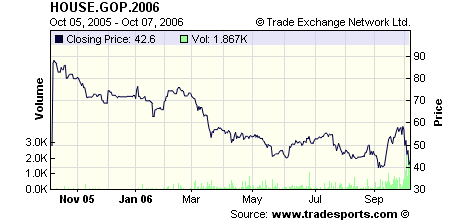
The betting at tradesports says the probability that the Republicans keep control of the House is now 34 percent. However, three political scientists have looked at the data and concluded:

Based on current generic ballot polls, we forecast an expected Democratic gain of 32 seats with Democratic control (a gain of 18 seats or more) a near certainty.
Thanks to Statistical Modeling for the pointer.

Monday, October 23, 2006

Henry George on Free Trade

Henry George, the 19th century economist and social reformer, is best known as an advocate for taxes on land (as discussed in Chapter 8 of my favorite economics textbook). But these quotations about trade (via Larry Kudlow) show that he was passionate about other topics as well:
I was educated a protectionist and continued to believe in protection until I came to think for myself and examine the question.
-Henry George

Free trade consists simply in letting people buy and sell as they want to buy and sell. Protective tariffs are as much applications of force as are blockading squadrons, and their objective is the same--to prevent trade. The difference between the two is that blockading squadrons are a means whereby nations seek to prevent their enemies from trading; protective tariffs are a means whereby nations attempt to prevent their own people from trading.

- Henry George, Protection or Free Trade 1886
Amen.

Economic Journalism

Here's a video of five economics journalists (Peter Coy, Greg Ip, Steve Liesman, Eduardo Porter, and Andrew Serwer) discussing their jobs at an event at Dartmouth. It takes about 90 minutes.

Thanks to Voxbaby for the pointer.

Sunday, October 22, 2006

Why firms are holding more cash

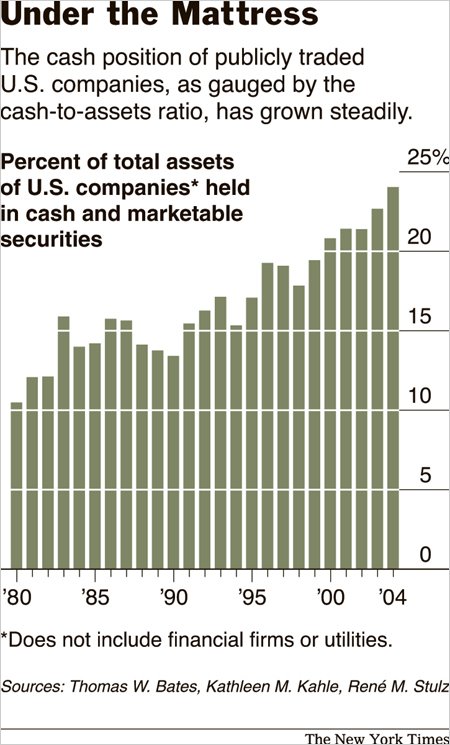
Today's NY Times explains why U.S. corporations are increasing their holdings of liquid assets:

Upon analyzing a dozen factors that economic theory suggests could play a role, the professors [Thomas W. Bates, Kathleen M. Kahle, and René M. Stulz] found that the biggest was an increase in risk — as evidenced by factors like unpredictable cash flow. Corporations have become less able to count on steady cash flow from year to year, according to the professors, and despite the growth of a complex derivatives market, companies can’t adequately hedge this risk without holding more cash.
You can obtain the study from the NBER.

Saturday, October 21, 2006

What's a classical liberal to do?

The Economist says that Libertarians (aka Classical Liberals) may be the new swing voters:

In a new study from the Cato Institute, a libertarian think-tank, David Boaz and David Kirby argue that libertarians form perhaps the largest block of swing voters. Counting them is hard, since few Americans are familiar with the term “libertarian”. Mr Boaz and Mr Kirby count those who agree that “government is trying to do too many things that should be left to individuals and businesses”, that government, rather than promoting traditional values, “should not favour any particular set of values”, and that “the federal government has too much power”. Using data from Gallup polls, they found that, in 2005, 13% of the voting-age population shared all three views, up from 9% in 2002.

That is easily enough libertarians to tip an election. And their votes are up for grabs. In 2000 George Bush won 72% of the libertarian vote, to Al Gore's 20%, by repeating the mantra “My opponent trusts government. I trust you.” But in 2004, after Mr Bush increased the size of government and curtailed some civil liberties as part of the war on terror, his margin dropped to 59%-38%. The swing was as sharp in congressional races, too. Going back further, libertarians backed George Bush senior by 74%-26% in 1988. But when he sought re-election in 1992, they split evenly between him, Bill Clinton and Ross Perot. A group that can give the eccentric Mr Perot a third of its support must be really disgruntled.

But until they represent much more than 13 percent of the electorate, classical liberals won't feel completely at home in either major party.

Update: Here is the Boaz-Kirby study.

Defense Spending

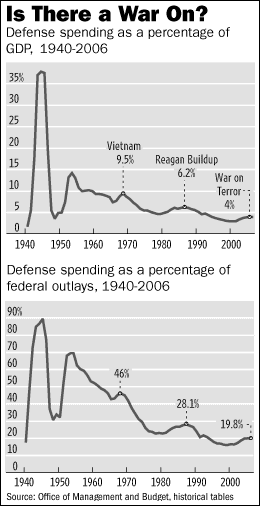
National defense is a classic example of a public good. But, as these charts from the Wall Street Journal show, it has been shrinking over the past half century, both as a share of the economy and as a share of overall federal spending. (Click on graph to enlarge.)

Economics as Computer Game

There is a long history of trying to teach economics with computer games. For example, when my first textbook came out in the early 1990s, students could buy supplementary software that included a Presidential Game in which they used the tools of monetary and fiscal policy to promote low inflation and robust and stable growth. That game is now available at the publisher's website.

NPR now tells us about a professor at UNC-Greensboro who has taken the concept of economic gaming to a new level. Thanks to Mark Thoma for the pointer.

Friday, October 20, 2006

General Education at Harvard

Harvard is considering a new set of general education requirements. The student newspaper, the Harvard Crimson, notices a glaring hole in the latest proposal:

Is Wal Mart a hero or a villain? Will immigrants help or hurt the wages of native workers? Do sweatshops alleviate or exacerbate poverty? Will a gasoline tax hurt oil companies or consumers? How does limiting trade affect a country’s well-being?

In a system of general education focused on providing students with knowledge relevant to being a global citizen, it’s hard to see how students should not be pushed to grapple with questions like these. To that end, we propose an additional area of inquiry and experience to be added to those proposed by the Task Force on General Education: “The Market and Society.”

When the Task Force’s report was released two weeks ago, it became readily apparent that the invisible hand was nowhere to be seen. Indeed, of the many current courses that are listed as examples that would fulfill various requirements, only two economics courses were cited—and both had extensive prerequisites. Social Analysis 10, "Principles of Economics," the College’s largest course, had no clear place. Some have speculated that the omission of economics may be a product of faculty backlash against former President Lawrence H. Summers....

For the most part we support the proposed general education system, its focus on relevance, its vision of broad courses, and its general structure. The omission of a course on markets, however, is glaring. We encourage the faculty to add “The Market and Society” to plug this hole in the preliminary report.

This suggested amendment sounds good to me.

The Pigou Club Manifesto

In today's Wall Street Journal, I offer a manifesto for the Pigou Club, the elite group of pundits and policy wonks with the good sense to advocate higher Pigovian taxes. (Click here for a partial membership list.)

Raise the Gas Tax
By N. Gregory Mankiw

With the midterm election around the corner, here's a wacky idea you won't often hear from our elected leaders: We should raise the tax on gasoline. Not quickly, but substantially. I would like to see Congress increase the gas tax by $1 per gallon, phased in gradually by 10 cents per year over the next decade. Campaign consultants aren't fond of this kind of proposal, but policy wonks keep pushing for it. Here's why:

The environment. The burning of gasoline emits several pollutants. These include carbon dioxide, a cause of global warming. Higher gasoline taxes, perhaps as part of a broader carbon tax, would be the most direct and least invasive policy to address environmental concerns.

Road congestion. Every time I am stuck in traffic, I wish my fellow motorists would drive less, perhaps by living closer to where they work or by taking public transport. A higher gas tax would give all of us the incentive to do just that, reducing congestion on streets and highways.

Regulatory relief. Congress has tried to reduce energy dependence with corporate average fuel economy standards. These CAFE rules are heavy-handed government regulations replete with unintended consequences: They are partly responsible for the growth of SUVs, because light trucks have laxer standards than cars. In addition, by making the car fleet more fuel-efficient, the regulations encourage people to drive more, offsetting some of the conservation benefits and exacerbating road congestion. A higher gas tax would accomplish everything CAFE standards do, but without the adverse side effects.

The budget. Everyone who has studied the numbers knows that the federal budget is on an unsustainable path. When baby-boomers retire and become eligible for Social Security and Medicare, either benefits for the elderly will have to be cut or taxes raised. The most likely political compromise will include some of each. A $1 per gallon hike in gas tax would bring in $100 billion a year in government revenue and make a dent in the looming fiscal gap.

Tax incidence. A basic principle of tax analysis -- taught in most freshman economics courses -- is that the burden of a tax is shared by consumer and producer. In this case, as a higher gas tax discouraged oil consumption, the price of oil would fall in world markets. As a result, the price of gas to consumers would rise by less than the increase in the tax. Some of the tax would in effect be paid by Saudi Arabia and Venezuela.

Economic growth. Public finance experts have long preached that consumption taxes are better than income taxes for long-run economic growth, because income taxes discourage saving and investment. Gas is a component of consumption. An increased reliance on gas taxes over income taxes would make the tax code more favorable to growth. It would also encourage firms to devote more R&D spending to the search for gasoline substitutes.

National security. Alan Greenspan called for higher gas taxes recently. "It's a national security issue," he said. It is hard to judge how much high oil consumption drives U.S. involvement in Middle Eastern politics. But Mr. Greenspan may well be right that the gas tax is an economic policy with positive spillovers to foreign affairs.

Is it conceivable that the policy wonks will ever win the battle with the campaign consultants? I think it is. Even after a $1 hike, the U.S. gas tax would still be less than half the level in, say, Great Britain, which last I checked is still a democracy. But don't expect those vying for office to come around until the American people recognize that while higher gas taxes are unattractive, the alternatives are even worse.

Update: Here and here.

Thursday, October 19, 2006

The Politics of Trade

It's getting ugly out there:

As lawmakers hit the home stretch of tight races, textile makers are leveraging voters' economic anxieties to win industry protections and derail free-trade initiatives.

Before Congress left Washington for final campaigning, anxious lawmakers shelved several items that the Bush administration had pushed as part of its trade agenda, but which the textile industry opposed. Now the question for the White House is how to get those efforts back on track -- especially if Democrats, who are traditionally less friendly to free trade, take control of one or both houses of Congress in November's voting.

The textile industry's maneuvering shows how Republican vulnerabilities in midterm elections have created opportunities for some special-interest groups....

when Bill Thomas, chairman of the House Ways and Means Committee, introduced a bill Sept. 21 that would give trade preferences to Africa and Haiti, lobbyists for Amtac and the National Council of Textile Organizations, another textile group, swung into action. They were especially worried about provisions in the bill that would allow Haiti to use more foreign-made fabric, such as cheap cloth from China, to make clothes, while still qualifying for duty-free access to the U.S. market.

The groups appealed to Rep. Robin Hayes, a North Carolina Republican, for help. A schoolteacher and former textile worker is running on the Democratic ticket in a closely watched race against Mr. Hayes, who agreed to lead the opposition against the Haiti bill. Mr. Hayes spoke to party leaders, then wrote a letter to Speaker Dennis Hastert arguing that the legislation could expose U.S. workers to "devastating" new competition.

The day before the Sept. 26 vote, lobbyists for the two textile groups took Mr. Hayes's letter and headed to Capitol Hill to rally support among other textile-district lawmakers. Ultimately, 16 Southern Republicans signed on....

Cafta [the Central American Free Trade Agreement] squeaked through the House by two votes, including one cast by Mr. Hayes. So when he sent Republican leaders the letter opposing the Haiti bill, they pulled the measure from the floor.

From yesterday's Wall Street Journal.

Leonhardt on Health Care

In yesterday's NY Times, David Leonhardt asks why Americans spend much more on health care than do the citizens of other countries, even though we don't seem to benefit with longer life expectancy:

The administrative costs of our patchwork bureaucracy eat up about 25 percent of health spending, which is why would-be reformers have long focused on these costs. But they aren’t the main story. Even in Europe’s single-payer systems, administrative costs account for about 15 percent of health spending, once everything is included, according to the Lewin Group, a consulting firm....

So something beside administrative costs is at work here, and it involves a basic cultural difference. Americans seem to be less willing to take no for an answer and more willing to try almost anything, no matter how expensive or how slim the odds, to prolong life. (The United States is also a fatter, more diverse country with wider income disparity, which gives our medical system a harder task.)

There are enormous benefits to the American refusal to go gently into that good night. It has made us obsessed with medical advances and turned this country into the world’s research laboratory. If you followed this year’s Nobel Prize announcements, you may have noticed that every scientific prize went to an American. Even hernia surgery, which has been around for 5,000 years, is now based in significant part on American methods, notes Raymond C. Read, a retired surgeon who has studied its history. Some of our spending, in short, goes to support medical care in other countries.

But much of it is simply wasteful. Expensive procedures — like some Alzheimer’s treatments, some knee surgeries and many body scans — are often no more effective than basic ones, according to research. Yet doctors can keep on getting reimbursed for the expensive ones. “Basically, anything that doesn’t kill patients is paid for by Medicare and insurance companies,” said Jonathan Skinner, a health care researcher at Dartmouth College.

If David is right, then the question is: What institution will we trust to say "no" to medical procedures that don't pass a cost-benefit test?

Pigou Club Update

The Washington Post gives the Pigou Club some much appreciated publicity.

Tuesday, October 17, 2006

A Few Things to Read

I have some speaking engagements to attend to over the next few days, so I won't be blogging much. Here are several things to keep you busy:

Blue Eyes and Marriage Patterns

The Boston Globe reports:

About half of Americans born at the turn of the 20th century had blue eyes, according to a 2002 Loyola University study in Chicago. By mid-century that number had dropped to a third. Today only about one 1 of every 6 Americans has blue eyes, said Mark Grant, the epidemiologist who conducted the study....

A century ago, 80 percent of people married within their ethnic group, Grant said. Blue eyes -- a genetically recessive trait -- were routinely passed down, especially among people of English, Irish, and Northern European ancestry.

By mid-century, a person's level of education -- and not ethnicity -- became the primary factor in selecting a spouse. As intermarriage between ethnic groups became the norm, blue eyes began to disappear, replaced by brown.

Harvard, the world's most elite dating agency, has most likely contributed to this trend.

Tierney on Wal-Mart and Sweatshops

A great John Tierney column in today's NY Times. A brief excerpt:
Has any organization in the world lifted more people out of poverty than Wal-Mart?...Making toys or shoes for Wal-Mart in a Chinese or Latin American factory may sound like hell to American college students -- and some factories should treat their workers much better, as Strong readily concedes. But there are good reasons that villagers will move hundreds of miles for a job. Most ''sweatshop'' jobs -- even ones paying just $2 per day -- provide enough to lift a worker above the poverty level, and often far above it.
We will be discussing the sweatshop debate later in the semester in ec 10.

Mallaby on Evan Bayh

Washington Post columnist Sebastian Mallaby takes a look at POTUS wannabe Evan Bayh:

With Mark Warner out of the 2008 Demstakes, the chief anti-Hillary centrist is Sen. Evan Bayh of Indiana. This is a depressing commentary on the state of the Democratic Party. Bayh may have cleared his schedule to woo Warner supporters on Thursday. But he has yet to prove himself a real contender -- and he may not be a real centrist, either.

Two weeks ago Bayh circulated a preposterous letter to his Senate colleagues. It urged them to oppose what Bayh called "documented unfair trade" in a type of steel that's used in vehicles. It noted the Commerce Department's finding that lifting the tariff on this steel would lead to dumping by foreign producers. That would hurt U.S. steelmakers, the letter continued; so when the fate of the tariff is considered at a sunset review tomorrow, it should on no account be lifted.

Presidential aspirants are supposed to champion the national interest, not special interests. Someone should tell Democratic hopeful Sen. Evan Bayh of Indiana. This is not a policy that protects workers, as Bayh's letter pretended. It's a sellout to a self-serving lobby. It would help the steel guys at the expense of the car guys, even though the car guys are hurting more and they employ more workers.

The tariff that Bayh wants to preserve is one of more than a hundred that protect the steel industry. These fortifications were erected on the theory that the steel business is inherently unfair because every nation in the world wants its own steelmaker. The creation of these national champions guarantees global oversupply of steel, or so the argument used to go. Therefore the United States had to protect itself from dumpers' unfairly low prices.

This argument was always flawed. If foreigners wanted to sell artificially cheap steel, the United States should have been happy to pocket the subsidy. But the protectionist argument is now worse than flawed, because the steel industry has changed substantially. A wave of mergers has rationalized some of the old national champions, and the alleged oversupply of steel has disappeared in the face of exploding demand from developing countries.

I don't know what Bayh's position is on candlemakers.

By the way, the sentence I put in bold is a standard argument which, I have learned, convinces most economists but almost no one else.

Monday, October 16, 2006

Phelps on Taxes

Ned Phelps, the latest econ Nobelist, talks to the Wall Street Journal and gives some policy advice that neither political party will embrace:

WSJ: Barring a breakthrough in productivity, how can the U.S. solve the problem of its impending obligations? Should it raise taxes or cut Social Security benefits?

Prof. Phelps: Over the last couple decades, the federal government has virtually abolished taxation of a wide swath of people with smallish incomes. This was a mistake, because we need all the tax revenue we can get. It's inefficient to have low marginal tax rates on low incomes, because people with upper middle incomes and high incomes get the same breaks, but they don't get any incentive to work harder. What you want to do is give tax breaks that give people an incentive to earn income that would not otherwise be earned. So in my view, President Bush should have restored the taxes on the low-income people rather than lowering the taxes on the high-income people.

U.S. and European Inequality

Income inequality in the United States is greater than it is in western Europe. Average income is also higher in the United States. This graph (source) puts those two well-known facts in a new light. (Click on the graph to enlarge.)

The bottom line: The poor in the United States have about the same real income as the poor in western Europe. The rich in the United States, however, are much richer.

Sim-1040

From today's Washington Post, believe it or not:

Virtual economies attract real-world tax attention

Users of online worlds such as Second Life and World of Warcraft transact millions of dollars worth of virtual goods and services every day, and these virtual economies are beginning to draw the attention of real-world authorities.

"Right now we're at the preliminary stages of looking at the issue and what kind of public policy questions virtual economies raise -- taxes, barter exchanges, property and wealth," said Dan Miller, senior economist for the Joint Economic Committee of the U.S. Congress.

"You could argue that to a certain degree the law has fallen (behind) because you can have a virtual asset and virtual capital gains, but there's no mechanism by which you're taxed on this stuff," he told Reuters in a telephone interview.

Neat Proofs


Thanks to Mahalanobis for these.

Welcome, American number 300,000,000

The U.S. population is about to reach 300 million. Am I concerned about overpopulation? No, I am not.

Update: Richard Posner is more concerned. Gary Becker is not.

Sunday, October 15, 2006

Prop 87 is not Pigovian

An ec 10 student asks me whether the Pigou Club approves of Prop 87, a ballot initiative in California, described by San Francisco Chronicle as follows:

Prop. 87 aims to raise $4 billion by placing a new tax on oil production, in addition to taxes oil companies already pay. The money would be used to finance research and development of alternative fuels; education campaigns; and subsidies to consumers who buy vehicles that use alternative fuels and businesses that produce and distribute alternative fuels.
The measure is supported by both Bill Clinton and Al Gore.

The goal of Pigovian taxes is to ensure that market prices reflect social costs. Once private and public interests are aligned, people are then free to make their own decisions over the allocation of resources, and they will have the right incentives to reach an efficient outcome.

By contrast, this measure seems more like government central planning. Indeed, the spending side of the proposition is exactly that. But what about the tax itself? Advocates claim that the tax would not be passed on to consumers. Given that oil prices are set in a world market, this claim seems about right to me. Most of the tax would likely be paid by local oil producers rather than oil consumers. Although this lack of pass-through to consumers may make the tax more attractive politically, it means that there would be no incentive working through the price system for people to cut back on oil consumption.

From a Pigovian perspective, the tax proposed by Prop 87 makes sense only if there are negative externalities from oil production in California. If we want Californians to produce less oil and import more from Saudi Arabia and Venezuela, then the proposed tax is well designed. But this goal does not seem the right one to me. I see negative externalities flowing from oil consumption rather than domestic oil production.

I doubt, therefore, that a majority of the Pigou Club would support the measure. But I am only one member. If the Club ever has a meeting, I will make sure to put the question on the agenda.

Gilbert on Happiness

Harvard psychologist Dan Gilbert gives a great talk at the TED conference on the secrets of happiness. It takes 22 minutes.

Barone on John Edwards

Michael Barone comments on POTUS wannabe John Edwards and poverty in America:

His stump speech includes a line about a little girl whose parents couldn't afford a winter coat. Give me a break. You can buy a little girl's winter coat at Wal-Mart for $10. That's the price of taking the little girl out to lunch at McDonald's. As Juan Williams points out in his book Enough: The Phony Leaders, Dead-End Movements, and Culture of Failure That Are Undermining Black America—and What We Can Do About It, no one in America is stuck in poverty if he or she does three things: graduates from high school; gets a job, any job; refrains from having children before getting married. Poverty comes not from any structural failure of society but from dysfunctional behaviors. Edwards's poverty shtick is a crock.
Barone fails to mention that we have textile and clothing imports to thank for all those cheap coats.

Saturday, October 14, 2006

Why MicroCredit?

Muhammad Yunus, the recent winner of the Nobel Peace Prize, explains why he prefers to help the world's poor with loans rather than grants of financial aid:

Many people ask, Why not just give free cash, especially under such dire circumstances? In Bangladesh, we've learned that when aid is free, not only do the poor get the least of it, but everyone inflates their needs. While some handouts are clearly necessary in such times, we focus on lending small amounts of money. This lets us keep costs down and rebuild funds for the next disaster. Most importantly, our Grameen banks are ready to act at a moment's notice. They can respond to a disaster without waiting for anyone's permission, immediately becoming like humanitarian agencies by suspending loan payments, and providing cash, food and medicines. Once rebuilding starts, the bankers keep detailed records of the money lent, and people are allowed to repay bit by bit.
Here is the entire Yunus article.

On Cell Phones and Indian Fishing

Sunday's Washington Post has a fascinating article about how cell phones have revolutionized the Indian fishing industry. (Yes, you read that correctly.)

The reader who alerts me to this story also sends along a paper on the topic by Kennedy School professor Robert Jensen. As far as I know, the paper is not available on the web, but here is the abstract:

When information is limited or costly, agents are unable to engage in optimal arbitrage. Excess price dispersion across markets can arise and goods may not be allocated efficiently; in this setting, information technologies may improve market performance and increase welfare. Between 1997 and 2001, mobile phone service was introduced throughout Kerala, a state in India with a large fishing industry. Using micro-level survey data, we show that the adoption of mobile phones by fishermen and wholesalers was associated with a dramatic reduction in price dispersion, the complete elimination of waste and near-perfect adherence to the Law of One Price. Both consumer and producer welfare increased.
The paper is forthcoming in the Quarterly Journal of Economics.

Signaling at the AEA Job Market

If you are an econ grad student about to go on the job market, this post is for you.

A PhD candidate from the University of Michigan sends me an email:

Hi Greg,

As a possible blog idea that would be well received by many econ grad students around this time each year, perhaps you could offer some thoughts as to the econ job market. How to best go about it, how to reduce noise in the process, how to sell oneself appropriately, ... Some insight as to the new signalling system offered by the AEA would also be most welcome! The latter is raising some real questions in my neck of the woods among this year's outgoing cohort (of which I'm one). Some like the idea as helping to reduce noise in the process by identifying some individuals' strong preferences. Others fear the inevitable interview question: "Why didn't we get a signal from you?" which can best be avoided by not sending any signal!

We'd all your insight on this whole process!

Best,
[name withheld]


On the job market in general, please see the links in a previous post.

Before receiving this email, I didn't know anything about the new AEA signaling system. I guessed (correctly, it turns out) that my Harvard colleague Al Roth would have something interesting to say. I emailed Al and got this in reply:

Hi Greg:

Indeed, I'm the chair of the AEA ad hoc committee on the Economics job market that put the new signaling mechanism into effect. (Last year we introduced the "scramble" web page in March, which will also operate this year.)

Just as the idea of the scramble was to add some thickness to the late (March-April) part of the market, the idea of signaling is to reduce some of the congestion in the thick, January interviews part of the market.

(Incidentally, Muriel Niederle is giving a seminar on it this Tuesday, in the behavioral/experimental seminar. She is on the committee too, and is doing some related theoretical work with Peter Coles.)

In terms of advice, we wrote the (attached) document, which also appears on the web now. [See the first link given above.] I'm also enclosing the scramble document which appeared last year and which isn't now on the web, but a revised version will reappear later in the market.

The basic idea of a signaling mechanism is that there is a big part of the market in which departments, in allocating scarce interview slots, have to form an assessment not only of how promising a student looks, but also of how likely that student is to be interested in them. (Harvard doesn't spend a lot of time worrying about that, but at Pitt, where I spent many happy years before coming to Harvard, we definitely factored that into our decisions.)

Of course students can send any signals they want in their cover letters, but because every cover letter expresses interest, that may be of limited help to departments in separating the signals from the noise. To some extent that may also apply to information in emails and letters from advisors. Those channels can all convey valuable signals of interest, of course. The new signaling mechanism is just a supplement to the traditional ways of signaling interest, and may be of most help to students who are interested in places to which they don't have other reliable means of conveying their interest. Because they can send a maximum of two signals through the AEA mechanism, the signals may convey some information.

So, what information should students try to convey? In our "advice to applicants" paragraph, we said

"The two signals should not be thought of as indicating your top two choices. Instead, you should think about which two departments that you are interested in would be likely to interview you if they receive your signal, but not otherwise (see advice to departments, above). You might therefore want to send a signal to a department that you like but that might otherwise doubt whether they are likely to be able to hire you. Or, you might want to send a signal to a department that you think might be getting many applications from candidates somewhat similar to you, and a signal of your particular interest would help them to break ties. You might send your signals to departments to whom you don't have other good ways of signaling your interest."

Basically we don't think students will often want to signal MIT or Princeton or Stanford or Chicago or other very competitive departments very often, because those departments can somewhat safely presume that they'll have a reasonable chance of being attractive to any students they interview. And we expect that departments will understand that they may not get signals from applicants who can demonstrate clear interest in other ways. So, in our advice to departments, we wrote

"Applicants can only send two signals, so if a department doesn't get a signal from some applicant, that fact contains almost no information. (See advice to applicants, below, which suggests how applicants might use their signals). But because applicants can send only two signals, the signals a department does receive convey valuable information about the candidate's interest.

A department that has more applicants than it can interview can use the signals to help break ties for interview slots, for instance. Similarly, a department that receives applications from some candidates who it thinks are unlikely to really be interested (but might be submitting many applications out of excessive risk aversion) can be reassured of the candidate's interest if the department receives one of the candidate's two signals."

If you wanted to give a very toy model of why signaling might be useful, you might want to start with the two-firm, two-applicant example in which on one even cares who works for whom, but each firm has only one interview slot, and can only hire someone they have interviewed. Then the symmetric equilibrium involves randomization (each firm randomly chooses one applicant to interview), and there is coordination failure half the time (when both firms interview the same applicant, so only one hire is accomplished). But if applicants can first send one signal, then even if they randomize to whom they send the signal (since they don't care in this simple example), then coordination failure is cut in half, if each firm adopts the strategy of interviewing the applicant whose signal they get in case they get exactly one signal. (Now, coordination failure is only a possibility when both applicants signal the same firm, in which case both firms randomly choose who to interview, which is the situation that existed in the absence of any signal...)

Al Roth

Thanks, Al.

Gabaix on CEO Pay

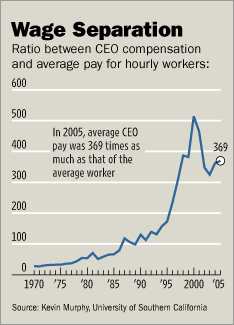
One highlight of my week was attending a seminar by Xavier Gabaix, the young star economist who was formerly a student in the Harvard PhD program and is now on the Princeton faculty. Xavier presented his paper on CEO pay . The above graph, from the Wall Street Journal earlier this week, shows the striking fact in need of explanation.

Here is the abstract of the paper (coauthored with Augustin Landier):

This paper develops a simple equilibrium model of CEO pay. CEOs have different talents and are matched to firms in a competitive assignment model. In market equilibrium, a CEO’s pay changes one for one with aggregate firm size, while changing much less with the size of his own firm. The model determines the level of CEO pay across firms and over time, offering a benchmark for calibratable corporate finance. The sixfold increase of CEO pay between 1980 and 2003 can be fully attributed to the six-fold increase in market capitalization of large US companies during that period. We find a very small dispersion in CEO talent, which nonetheless justifies large pay differences. The data broadly support the model. The size of large firms explains many of the patterns in CEO pay, across firms, over time, and between countries.
In Xavier's view, CEO's are earning the value of their marginal product. Top CEOs are paid high salaries because they are directing the fortunes of large enterprises, and even a small amount of extra talent is worth a lot.

Some people on the left have suggested that high CEO pay is a reflection of poor corporate governance, which allows CEOs to, in effect, steal value from shareholders. Xavier tests for this possibility using a measure of corporate governance and concludes, "Poor governance does increase CEO pay, but the effect seems small."

Another aspect of Xavier's work, however, should appeal to those on the left: In his model, high CEO salaries are pure economic rents. CEOs are paid what they are worth to their companies, and their high pay reflects the extraordinary value of their talent, but the supply of talent is inelastic, and the allocation of talent would not be affected if everyone faced high tax rates.

Xavier's model encourages people to think of CEOs as similar to Tiger Woods. Woods makes a lot of money because he is really, really good at golf. He is not stealing from those companies that pay him millions for endorsements. To the people paying Woods for his services, he is worth every penny. Yet if Woods were taxed at 50 percent, rather than 35 percent, he probably wouldn't give up golf or forgo the lucrative endorsements. (Response from the right: On the other hand, at a higher tax rate, Woods might play fewer tournaments each year. He might retire earlier. He might take more compensation as untaxed fringe benefits, such as a cushy private jet to fly to tournaments. And so on.)

Have Gabaix and Landier found the right model of CEO pay? It is too early to say. But there is no doubt that their paper will be a focal point of the literature on this topic.

Friday, October 13, 2006

A Second Nobel for Economics

Bangladeshi banker and economist Muhammad Yunus, whose system of micro-credit loans reshaped development efforts in poor nations, won the Nobel Peace Prize today, along with the bank he founded.
From the online Washington Post this morning.

The Nopigou Club

It must be good news for the Pigou Club when someone takes the time to form the Nopigou Club.

Thursday, October 12, 2006

The Latest on Outsourcing

It appears that outsourcing may not be destroying life as we know it (or at least not yet).

Multinationals cut down on outsourcing

The wave of outsourcing that has engulfed the global economy over the past few years is showing signs of abating as multinational companies opt for shorter and smaller deals, according to a study to be published on Thursday.

The outsourcing industry has just experienced its worst quarter in four years and is unlikely to match the $81.9 bn in contracts won in 2005 by the end of this year, data from the consulting firm Technology Partners International shows.

A slowdown in 2006 would mark the second consecutive yearly fall in the volume of outsourcing contracts since their $84.7 bn peak reached in 2004.

The results suggest that, following the drive to curb costs and streamline operations by contracting out non-core functions, multinationals might be running out of major operations to outsource.

Henderson on Phelps

On the opinion page of today's Wall Street Journal (subscription required), David Henderson has a nice piece on Ned Phelps. An excerpt:
Edmund S. Phelps is difficult to categorize politically. On the one hand, he decries the lack of dynamism in Europe (as he did on this page on Tuesday) and wants European governments to deregulate their economies. On the other, he believes that low-end jobs don't pay enough and wants the government to subsidize such jobs. He understands that the minimum wage prices people out of labor markets, resulting in "idleness, deprivation, drugs and crime." So, in his 1997 book, "Rewarding Work: How to Restore Participation and Self-Support to Free Enterprise," he advocated a vast subsidy program that would have cost $125 billion in 1997 dollars, a whopping 1.5% of that year's GDP.

Wednesday, October 11, 2006

King on Monetary Policy

Mervyn King, the most charming central banker I know, offers his views about monetary policy in a globalized economy:

Some of you may be tempted to think that because the growth of the Chinese economy has affected key prices in our own economy, inflation in Britain is now largely determined overseas. Low inflation in industrialised countries, it is argued, is made in China. As with the Arthurian legends, epitomised by King Arthur’s Round Table above us, that too is a myth. Despite large changes in relative prices, the average change in prices – inflation – has been remarkably stable. Indeed, it is striking that in a decade in which prices moved so much, overall inflation was more stable than in any decade for a hundred years. It was a decade that in my first speech as Governor, I described as NICE– a non-inflationary consistent expansion.

How can inflation be stable when individual prices move around so much? The explanation is that inflation is the result, in the old adage, of too much money chasing too few goods. Inflation arises when the total amount of money spending (or nominal demand) in the economy is greater than the value today of the available goods and services. When the Bank of England changes Bank Rate to keep consumer price inflation close to the target of 2%, we influence – albeit imprecisely and with a time lag – the amount of money spent in the economy and so the inflation rate.

In short, inflation is made at home.

Goofiest Headline of the Year

You Might Have Him To Thank for Your Job
Professor Who Solved Stagflation Wins Nobel

From yesterday's Washington Post, writing about Ned Phelps.

Actually, given the fields in which we work, Ned may well have written an evaluation letter about me when I came up for tenure, so perhaps I do have him to thank for my job. But I doubt the same is true of the typical Washington Post reader.

Are all economists free-market purists?

Some of my fellow academics may think of economists as the right wingers on the faculty. A recent survey, however, suggests that most economists are moderates.

Is There a Free-Market Economist in the House? The Policy Views of American Economic Association Members

By Daniel B. Klein and Charlotta Stern

People often suppose or imply that free-market economists constitute a significant portion of all economists. We surveyed American Economic Association members and asked their views on 18 specific forms of government activism. We find that about 8 percent of AEA members can be considered supporters of free-market principles, and that less than 3 percent may be called strong supporters. The data is broken down by voting behavior (Democratic or Republican). Even the average Republican AEA member is middle-of-the-road, not free-market. We offer several possible explanations of the apparent difference between actual and attributed views.

According to the survey, the policy issues on which there is a particularly large divide between Democratic and Republican economists are the minimum wage, gun control, and redistribution. The issue of "tariffs to protect American industries" generates the strongest opinions overall; naturally, economists of both parties are opposed.

The paper considers several reasons why economists are often misperceived as free-market purists. Here is an excerpt:

Probably one of the most significant explanations for the erroneous free-market attribution is that almost all scholarly free-market supporters are economists. The center columns of Table 5 [actually Table 6] show that free-market supporters are practically non-existent in anthropology, history, political science, and sociology. There is a familiar heuristic bias of confusing a statement with its inverse. That is, if people perceive that every free market professor is an economist, they may slip into thinking that a preponderance of economists are free-market.
That sounds plausible to me.

Tuesday, October 10, 2006

Phelps on Capitalism

On the opinion page of today's Wall Street Journal, the newest nobelist Ned Phelps has a long essay comparing the U.S. economy to those of continental western Europe. The bottom line:
the free enterprise system is structured in such a way that it facilitates and stimulates dynamism while the Continental system impedes and discourages it....I conclude that capitalism is justified -- normally by the expectable benefits to the lowest-paid workers but, failing that, by the injustice of depriving entrepreneurial types (as well as other creative people) of opportunities for their self-expression.
I recommend the entire article to give a good sense of Ned's worldview and writing style. Unfortunately, subscription is required.

Update: A commenter finds a free link to the article.

Pigou in MA

The Pigou Club is not doing well in my home state of Massachusetts. Two days ago, the Boston Globe reported:
A special state commission is expected to call for a 9-cent a gallon increase in the gas tax and reinstatement of tolls that had been eliminated in Western Massachusetts and in West Newton, according to two panel members.
The political reaction, reported the next day, was disappointing:
Gubernatorial candidates Deval Patrick [Democrat], Christy Mihos [Independent], and Lieutenant Governor Kerry Healey [Republican] yesterday came out in opposition to a gas tax increase being considered by a state commission studying transportation needs in Massachusetts.
I have to keep reminding myself that Sisyphus is my role model.

Monday, October 09, 2006

ROTC

Over at the Open University blog, Darrin McMahon reports a striking statistic:

as recently as 1956, 400 members of the Princeton graduating class of 750 served in the armed forces. In 2004, that number was down to 9. And Princeton is positively military friendly when compared to schools like Harvard or Yale, where the faculty decided in 1969 that ROTC programs had no place on a progressive campus of lux et veritas. Despite the efforts of a vocal minority, the ban has not yet been lifted.
I have long thought that Harvard should bring ROTC back.

In my view, Harvard has a moral obligation to play an appropriate role in our nation's defense. No one benefits more from the freedoms that the military defends than academics, who use the freedoms of expression more liberally than the average American. It seems particularly reprehensible for us to free ride as completely as we do.

In addition, from a purely self-interested standpoint, Harvard as an educational institution would benefit from having more students who are considering a military career. If one judges "diversity" by worldview rather than merely skin color, more ROTC students would substantially increase the diversity of Harvard's student body. Their presence would enrich discussions in various history and government classes.

Finally, ROTC at Harvard would extend the university's reach in the world. We have run into diminishing returns filling the ranks of investment banking and management consulting. Wouldn't it be great if some of the next generation of military leaders launched their careers at Harvard? If the Harvard faculty wants to have influence, they should be eager to teach the next Colin Powell.

Some faculty see the Harvard ROTC ban as a protest against the federal government's treatment of gay military personnel. But to me the form of the protest seems particularly sanctimonious, as the faculty are asking for a sacrifice from others (in particular, from potential ROTC students and from other students who would benefit from a more diverse student body), while giving up relatively little themselves. I propose that any professor who wants to protest federal policy can do so personally by refusing to apply for or accept any grants from the federal government.

The envelope, please

This year's Nobel prize in economics goes to Edmund Phelps "for his analysis of intertemporal tradeoffs in macroeconomic policy."

A wonderful choice. To learn more, you can read the committee's summary of Ned's contributions.

Addendum: In the Nobel pool here in Cambridge, there were 209 entries. The favorites were Bengt Holmstrom (11.5%), No Correct Guess (10%), Robert Barro (10%), Oliver Hart (9%), Eugene Fama (7%), and Oliver Wlliamson (6%).

Update: I am told that one person out of 209 entries bet on Phelps.

Putnam on Diversity

This is the most disturbing piece of research I have read about recently.

Study paints bleak picture of ethnic diversity

A bleak picture of the corrosive effects of ethnic diversity has been revealed in research by Harvard University’s Robert Putnam, one of the world’s most influential political scientists.

His research shows that the more diverse a community is, the less likely its inhabitants are to trust anyone – from their next-door neighbour to the mayor....

The core message of the research was that, “in the presence of diversity, we hunker down”, he said. “We act like turtles. The effect of diversity is worse than had been imagined. And it’s not just that we don’t trust people who are not like us. In diverse communities, we don’t trust people who do look like us.”

Update: Putnam disputes this article's interpretation of his work.

Sunday, October 08, 2006

Gasoline Taxes around the World

From today's NY Times. The article by Daniel Gross gives the Pigou Club some much appreciated publicity.

Saturday, October 07, 2006

How to Write Well

When I was CEA chair, I sent the following guidelines to my staff as they started drafting the Economic Report of the President. A friend recently emailed me a copy, and I thought I would share them with blog readers. They are good rules of thumb, especially for economists writing for a general audience.

ERP Writing Guidelines

  • Stay focused. Remember the take-away points you want the reader to remember. If some material is irrelevant to these points, it should probably be cut.
  • Keep sentences short. Short words are better than long words. Monosyllabic words are best.
  • The passive voice is avoided by good writers.
  • Positive statements are more persuasive than normative statements.
  • Use adverbs sparingly.
  • Avoid jargon. Any word you don’t read regularly in a newspaper is suspect.
  • Never make up your own acronyms.
  • Avoid unnecessary words. For instance, in most cases, change
    o “in order to” to “to”
    o “whether or not” to “whether”
    o “is equal to” to “equals”
  • Avoid “of course, “clearly,” and “obviously.” Clearly, if something is obvious, that fact will, of course, be obvious to the reader.
  • The word “very” is very often very unnecessary.
  • Keep your writing self-contained. Frequent references to other works, or to things that have come before or will come later, can be distracting.
  • Put details and digressions in footnotes. Then delete the footnotes.
  • To mere mortals, a graphic metaphor, a compelling anecdote, or a striking fact is worth a thousand articles in Econometrica.
  • Keep your writing personal. Remind readers how economics affects their lives.
  • Remember two basic rules of economic usage:
    o “Long run” (without a hyphen) is a noun. “Long-run” (with a hyphen) is an adjective. Same with “short(-)run.”
    o “Saving” (without a terminal s) is a flow. “Savings” (with a terminal s) is a stock.
  • Buy a copy of Strunk and White’s Elements of Style. Also, William Zinsser’s On Writing Well. Read them—again and again and again.
  • Keep it simple. Think of your reader as being your college roommate who majored in English literature. Assume he has never taken an economics course, or if he did, he used the wrong textbook.

Speaker Pelosi


According to the betting at tradesports.com, the probability that the Republicans keep control of the House is now 44 percent.

Oct 14 Update: It's now down to 37 percent.

Women in Science

Richard Posner and Gary Becker dis the Shalala Report. If Larry Summers writes something on the topic, I will post an update.

Nobel Predictions

Today's Wall Street Journal joins in the speculation:

The Royal Swedish Academy of Sciences will announce its choice on Monday for the Nobel Memorial Prize in economics. As the day approaches, some of the world's best minds are engaged in a highly inexact science: predicting the winner.

The outcome is far from trivial. Though the winning work of Nobel laureates tends to be decades old, the prize confers great benefits beyond the purse of about $1.4 million, including a renewed influence in the public realm, canonical status and coveted bragging rights for the universities whose halls the laureates haunt. To date, the University of Chicago leads with nine laureates. Harvard has four, and MIT three....

Academics see several areas and names as "ripe" for a Nobel. Among the favorites: Harvard's Oliver Hart, whose work in contracts has helped economists understand why companies merge and split apart; Robert Wilson and Paul Milgrom, both of Stanford University, whose work in auction theory inspired the design of radio-spectrum selloffs; Columbia's Jagdish Bhagwati, whose work demonstrated that trade barriers are among the worst ways to solve domestic economic problems; and Chicago's Eugene Fama, whose idea that stock-price moves can't be predicted spawned a whole industry of specialized index funds.

Thomson Scientific, which produces an annual list of front-runners based on how many peers cite an economist's work, forecasts three possible combinations: Mr. Bhagwati, together with Princeton trade specialists Avinash Dixit and Paul Krugman; Mr. Jorgenson alone; and Mr. Hart, together with Bengt Holmstrom of Harvard and Oliver Williamson of Berkeley. Betting pools at Harvard and MIT favor Cambridge, Mass., locals such as Mr. Hart, Mr. Holmstrom and Harvard macroeconomist Robert Barro.

The following winners were on the Harvard faculty for part of their careers, sometimes very briefly: Kuznets, Merton, Arrow, Leontief, Schelling, Spence, Sen, and Fogel. But only the first four were on the faculty when they won the prize . We are, however, happy to take some credit for all of them, and also for those who were once students here, such as Samuelson, Solow, and Tobin.

Friday, October 06, 2006

Thomas Schelling

You can watch a tribute to economist Thomas Schelling, held at Harvard yesterday. It takes about an hour. Schelling starts talking about half way through. He reflects on what it's like to win the Nobel, on his work in game theory, and on U.S. defense policy.

Home Runs, Base Hits, and Nobel Prizes

Because this is Nobel season, faculty lunch at Harvard this week turned, naturally, to speculation about possible winners of the economics prize, which is to be announced Monday. (My older colleagues happened to be absent. Otherwise, the topic would have be a bit too awkward to broach.) I won't repeat the speculation about names, but a broader issue came up: What should the criterion be?

There was an apparent consensus that the Nobel committee prefers rewarding people for a few path-breaking works, rather than judging an entire career of contributions. Is this optimal?

If the goal is to provide researchers with the right incentives, it may not be. It is as if a baseball team paid players based only on the number of home runs. We would have too many players swinging for the bleachers and too few base hits. In economics, maybe we get too many of the best people trying to create new paradigms and too few engaged in more routine, applied research.

Update: Tyler Cowen has an interesting take on what the Nobel committee should aim for:

I see the welfare-maximizing use of the Nobel Prize as generating more publicity for economics, attracting more people to study the science, and giving the science greater credibility in the eyes of politicians, the public, and media. That means the committee should give prizes to economists who are articulate, intelligible, scholarly, and work on topics of real world interest. So far they have done a great job; let's hope for another first-rate pick.
The Nobel winners have extraordinary scholarly accomplishments, but compared to the typical top 1000 economist, are they really much more articulate, intelligible, and focused on topics of real world interest? I would like to think so, but I am not sure.

Ig Nobels of Economics

A blog reader asks me why there weren't any Ig Nobels in economics this year. I don't know the answer, but there have been economic winners in past years. Here are a couple examples from Wikipedia:

1993 - Presented to Ravi Batra of Southern Methodist University, shrewd economist and best-selling author of The Great Depression of 1990 and Surviving the Great Depression of 1990, for selling enough copies of his books to single-handedly prevent worldwide economic collapse.

2001 - Presented to Joel Slemrod, of the University of Michigan Business School, and Wojciech Kopczuk, of the University of British Columbia, for their conclusion that people find a way to postpone their deaths if that would qualify them for a lower rate on the inheritance tax.

The paper by Kopczuk and Slemrod was published by the Review of Economics and Statistics, a journal run by some of my colleagues here at Harvard.

How to Ration Flu Vaccines

Today's Wall Street Journal asks a fascinating question about the allocation of scarce resources: If you have a limited number of flu vaccines, who should get them?

In May, scientists at the National Institutes of Health stirred things up with a paper calling into question the policy that aims to save the most lives by first vaccinating the old, the very young and the sick, putting last those who are two to 64 years of age. The value of a life, they argued, depends on age. A 60-year-old has invested a lot (measured by education and experience) in his life, but has also reaped most of the returns. A child has minimal investment. A 20-year-old has great investment but has reaped almost none of the returns. Conclusion: To maximize investment in a life plus years of life left, 13- to 40-year-olds should have first claim on rationed vaccine, explains NIH's Ezekiel Emanuel....

Evidence keeps accumulating that vaccinating the elderly might not even be the best strategy for minimizing deaths. The reason is that during some flu pandemics, the mortality rate among the elderly is hardly higher than during nonpandemic years. The flu certainly kills some old people, says Dr. Emanuel, but many would have died anyway. In addition, they may not benefit from flu vaccines as much as is assumed: A 2006 study found that the antibody response by people over 65 is less than half that in young adults....

The common-sense notion that vaccinating the elderly is the best way to save the elderly also deserves scrutiny, according to a study this week in the journal PLoS Medicine. Infants and the elderly don't spread the flu as much as, say, a schoolchild or business traveler. Might you decrease both illness and death, including among the old, by vaccinating other age groups first?

Thursday, October 05, 2006

Epstein on Intellectual Breadth

As a person with broad interests (short attention span), I enjoyed this passage from the prominent legal scholar Richard Epstein:

I have gone through much my entire academic career by trying to answer one question: just what do you specialize in, Professor Epstein? And my invariable answer to that question is “nothing, really.”

In fact, when I was very young and teaching at USC, my then new colleague, the late Gary Bellow asked, “What will you teach next year?” And I said, “Whatever I'm asked to do,” to which Bellow replied, "No utility infielder has ever made it into the hall of fame, and so you've got to figure out what it is that you want to specialize in."

It occurred to me that he was probably right, but nonetheless I decided to disregard the advice and to continue on my errant ways. And that intellectual mindset, in fact, has led to the simple truth that I'm an outsider to every intellectual field in which I participate.

Cowen on U.S. Health Spending

In today's NY Times, Tyler Cowen says:
The American health care system, high expenditures and all, is driving innovation for the entire world.
One timely piece of evidence:
In the last 10 years, for instance, 12 Nobel Prizes in medicine have gone to American-born scientists working in the United States, 3 have gone to foreign-born scientists working in the United States, and just 7 have gone to researchers outside the country.

Can growth in China be bad for the U.S.?

An economics instructor emails me a question about a problem in Chapter 3 of my principles text. Here is the problem:

7. Suppose that in a year an American worker can produce 100 shirts or 20 computers, while a Chinese worker can produce 100 shirts or 10 computers.

a. Graph the production possibilities curve for the two countries. Suppose that without trade the workers in each country spend half their time producing each good. Identify this point in your graph.

b. If these countries were open to trade, which country would export shirts? Give a specific numerical example and show it on your graph. Which country would benefit from trade? Explain.

c. Explain what price of computers (in terms of shirts) trade between the two countries might take place.

d. Suppose that China catches up with American productivity, so that a Chinese worker can produce 100 shirts or 20 computers. What pattern of trade would you predict now? How does this advance in Chinese productivity affect the economic well-being of the citizens of the two countries?

The problem generates this email:

Question 7 asks students to do a comparative advantage analysis of trade potential between China and the US.

In this problem regarding comparative advantage and trade the answer to part d provides fuel for a zero-sum outlook. When my students crunch the numbers they see that the gain in China's productivity eliminates the incentive for trade. Indeed, it appears that while China gains in productivity the US loses both the opportunity to buy shirts for a relatively lower price (creating inflation pressure within the US?) and the opportunity to "profit" by selling computers to China. I confirmed that result in your on-line answer key.

Yet, the numeric answer doesn't make intuitive sense. I often follow your suggestion in teaching trade by asking students to think about trade between two cities in the same state or two states in the same country. We learn about how the bias of nationalism creeps into and can cloud our judgement about the impact of trade. Am I mistaken in suggesting that just as a a gain in productivity in one part of the US shouldn't reduce the standard of living elsewhere, nor should a gain in productivity anywhere in the world lower the overall material standard of living. But the numbers in 7d either challenge that statement or do not make that clear.

Perhaps this is a simplistic question with an obvious answer, but I am curious about how you teach this problem and what suggestions might you make?

I added this problem in the new edition after reading an article by Paul Samuelson in the Journal of Economic Perspectives (Summer 2004). Part d uses the tools available to ec 10 students to illustrate the essential point of the Samuelson article: Growth in China can make the United States worse off.

When it came out, the Samuelson article was widely misinterpreted as showing that outsourcing and trade with China were bad for the United States. In fact, what Samuelson and my textbook problem illustrate is that, while trade is beneficial for both countries, growth in China could be bad for the United States because it could cause us to lose some of those gains from trade. In the example, growth in the Chinese computer industry causes the two countries to become identical, so trade based on comparative advantage disappears. (The Samuelson paper and the public reaction to it are discussed more fully on pages 18 to 20 in my paper with Phill Swagel on outsourcing.)

I wouldn't describe this result as zero-sum: China is certainly better off from the productivity growth, and those gains need not equal U.S. losses. But the example does illustrate the principle that growth in one part of the world can create losers in another part. (Still not convinced? Here is a clear example: If New Zealand figured out a way to make a cheap gasoline substitute from sheep dung, the New Zealand economy would boom, but Saudi Arabian incomes would surely suffer.)

Although this textbook problem is useful as a theoretical exercise, one should not overstate its practical relevance (as I believe Paul mistakenly did in his paper). In the example, the United States is made worse off by growth in China because our trade with China dries up, so we lose the gains from trade. This theoretical result has minimal application to the world as we see it today. World trade is booming, not shrinking.

Bernanke on Entitlements

The Washington Post reports:

Federal Reserve Chairman Ben Bernanke said Wednesday the burden from retiring baby boomers will strain the nation's budget and economy, unless Social Security and Medicare are revamped.

"Reform of our unsustainable entitlement programs" should be a priority, Bernanke told the Washington Economic Club. "The imperative to undertake reform earlier rather than later is great."...

Bernanke said that as the population ages, the United States will have to choose among higher taxes, fewer dollars for other programs, lower spending on entitlement programs, and a sharply higher budget deficit --or some combination of all those.

He is right, of course.

Being a circumspect Fed chairman, Ben does not tell us precisely what reforms he prefers, but his speech contains this hint:

A large increase in tax rates would surely have adverse effects on a wide range of economic incentives, including the incentives to work and save, which would hamper economic performance.
Once again, I agree.

Wednesday, October 04, 2006

Good news, but not good enough

The Harvard Crimson reports:

Ec 10 Sees Its Demand Rising

There’s nothing micro about the introductory microeconomics course Social Analysis 10. With 965 undergraduates enrolled in it this semester, the Core course better known as “Ec 10” is Harvard’s largest class—and it’s 42 percent larger than last year.

I won't be satisfied until I get every one of the almost 1700 first-year undergraduates.

Globalization and the Phillips Curve

Last week, I attended the Academic Consultants meeting at the Federal Reserve, where nerdy economics professors like me discussed globalization with Ben Bernanke (an erstwhile nerdy economics professor) and his colleagues. I was assigned to discuss a paper by Larry Ball on whether globalization has fundamentally changed inflation dynamics as described in modern Phillips curve equations. I thought readers of this blog might enjoy reading my discussion.

Comment on Ball
September 28, 2006

Thank you. I am delighted to be here in such august surroundings, in the company of so many old friends and colleagues.

I have to start, however, by saying that the organizers of this meeting made a big mistake when deciding to invite me, especially to discuss a paper by Larry Ball on inflation dynamics. It would take only a few minutes googling to figure out that Ball and Mankiw have more or less the same pedigree. Worse yet, we are frequent collaborators, especially on the subject of price dynamics. Asking me to comment on a Ball presentation is a bit like asking Teller to review Penn’s magic act, except unlike Teller, I really do talk.

So you shouldn’t be surprised to hear that I agree with most of Larry has to say. I would quibble with some details. For example, I think Larry’s paper is a bit unfair to my Harvard colleague Ken Rogoff, when he asserts that Ken fails to understand the difference between absolute and relative prices. But I agree with Larry’s bottom line that globalization is, mostly likely, not crucial for the analysis of inflation dynamics.

From the standpoint of the modern theory of the Phillips curve, price setting depends on two things—the prices that firms want to charge, and the rate at which firms adjust their actual prices to desired prices. If globalization were to change the inflation process, it would have to occur either by affecting desired prices or by affecting the adjustment process.

Desired prices are normally assumed to rise with the economy’s output for the same reason that marginal costs curve slope upward on the blackboard of my ec 10 class. Firms face diminishing returns as their output expands. In addition, when workers are working longer hours, they experience increasing marginal disutility of work, causing their real wage demands to rise, putting further upward pressure on marginal cost and desired prices. There is no particular reason that I can see to believe that globalization will change either the slope of the labor supply curve or the rate of diminishing returns reflected in the production function. If that supposition is right, then marginal cost is just as cyclically sensitive as ever.

To go from marginal cost to desired prices, we need to focus on the markup. I can easily believe that globalization has made many markets more competitive, reducing the size of typical markup of price over marginal cost. This is consistent with the view from business executives that they have no “pricing power”—that is, they face firm demand curves that are more elastic. This increase in competition may have provided a modest, one-off beneficial shock to the inflation process (perhaps spread over several years). But for purposes of understanding ongoing price dynamics, the average level of the markup is less important than the sensitivity of the markup to the business cycle.

There have been several theories of countercyclical markups floating around the literature. Julio Rotemberg of Harvard Business School, for example, writing sometimes with Garth Saloner and sometimes with Mike Woodford, has proposed a model of countercyclical markups in which markups rise in recessions because firms are better at maintaining collusive oligopolistic behavior. If the economy has become more competitive, then it seems possible that the relevance of the Rotemberg story has diminished over time. If so, then the markup will have become less countercyclical, so desired prices would fall more in recessions now than was previously the case. This hypothesis suggests that prices would be more sensitive to output in a globalized economy, which goes in the opposite direction from the evidence that Larry cites.

In the end of the day, I can’t see any compelling reason to believe that desired prices are less sensitive to cyclical conditions in a globalized economy that they would be in a more closed economy.

The second piece of the picture to consider is whether globalization changes the rate at which firms adjust actual prices in response to desired prices. Unfortunately, there is no consensus among macro theorists about why actual prices respond sluggishly. We don’t really know if the key to the mystery is long-term contracts, menu costs, imperfect information, customer annoyance at price changes, or inattentiveness on the part of price setters. And we are on even shakier theoretical ground when trying to figure out if globalization somehow changes this process that we still don’t understand. But my first guess would be that globalization increases competition, which in turn erodes some of the frictions that might impede price adjustment. If anything, we might expect inflation to respond more quickly to the business cycle, not less. Once again, theory most naturally points us in the opposite direction from the evidence.

Let me conclude by spending one minute indulging myself and offering you some thoughts on pop evolutionary psychology, which I think might be relevant here. When I was thinking about this meeting, I wondered why people are as focused on the topic of globalization and price dynamics as they are, especially because basic macro theory does not naturally lead one here. One answer is given by Larry in his conclusion: It is fun to think about big paradigm-shifting ideas like globalization. That is reinforced because globalization is a fashionable topic, with books like The World is Flat finding their way on to best seller lists. (By the way, I have asked the Harvard’s planetary science department about this Flat Earth hypothesis, and they assure me it’s not true.)

My sense is that, as a general matter, globalization as a phenomenon, while no doubt significant in many ways, nonetheless gets more attention than it deserves. We see this manifest itself in many ways. For example, the Chinese exchange rate is not a major issue facing the U.S. economy, yet somehow it manages to get a lot of attention, while more serious problems are routinely ignored.

Part of the explanation, I believe, is that human beings are programmed to be wary of foreigners. In the state of nature in which we evolved, one of the biggest risks we faced is that some other tribe would sneak up at night, steal our food, rape our women, and leave us for dead. As a result, we evolved to be on the constant lookout for risks that strangers might impose upon us.

That inbred fear of strangers manifests itself in many ways. Most perniciously, it is undoubtedly a source of racism and international conflict. But it also has some more benign effects. In particular, it leads central bank economists to spend too much time wondering what those malicious foreigners are doing to their econometric models of inflation dynamics. Which is, perhaps, one reason why we are all here today.

Tuesday, October 03, 2006

Stiglitz on Global Imbalances

In today's NY Times, economist Joe Stiglitz tells us how to deal with global imbalances, including the U.S. trade deficit. His answer: Cut government spending and make the tax code more progressive.

Here's Joe:

There is one way out of this seeming impasse: expenditure cuts combined with an increase in taxes on upper-income Americans and a reduction in taxes on lower-income Americans. The expenditure cuts would, of course, by themselves reduce spending, but because poor individuals consume a larger fraction of their income than the rich, the “switch” in taxes would, by itself, increase spending. If appropriately designed, such a combination could simultaneously sustain the American economy and reduce the deficit.

I can understand the argument for cutting government spending (although Joe ducks the hard question--deciding which spending to cut). Lower government spending would increase national saving, and increased national saving would in turn reduce our reliance on foreign capital inflows. The dollar would fall in foreign exchange markets, and the trade deficit would shrink. This is all textbook international macroeconomics (which we will discuss in ec 10 in the spring).

But increased progressivity is an odd prescription for global imbalances, for two reasons. First, Joe rests the case on different marginal propensities to spend for high-income and low-income taxpayers. Although there is strong evidence for different average propensities to consume, the evidence for substantially different marginal propensities is much weaker. And it is the marginal propensities that are key to Joe's story.

Second, even if I grant Joe the different marginal propensities, I can't see how this plan would work to balance global trade flows. If the tax switch increased consumer spending, then it would decrease national saving, offsetting the increase in national saving from reduced government spending. With national saving unchanged, I can't see how international capital flows and the trade deficit would be any different. In other words, if a decrease in public spending were matched by an increase in private spending, as Joe seems to suggest, the budget deficit would be smaller, but the trade deficit--the focus of Joe's article--would be the same.

I can understand why a left-leaning economist like Joe would favor increased progressivity: If a person wants to reduce inequality and is willing to pay the price of reduced efficiency (that is, if one is willing to shrink the economic pie in order to give everyone a more similar slice), then Joe's proposal is the way to go. But that's not the case that Joe is making, which is why I am puzzled. As a solution to global imbalances, increased progressivity of the tax system seems like a non sequitur.

A Small Case Study of Bad Journalism

A reader calls this sentence from The New Republic to my attention:
Mankiw...left his post as chair of the Council of Economic Advisors after publicly supporting offshoring.
The sentence is true in the same sense that this sentence is true:

Japan bombed Pearl Harbor after Thomas Jefferson completed the Lousiana Purchase.
Both sentences get the chronology right, but they mislead the reader by compressing the time line of events and insinuating a cause-and-effect that is absent in the historical record. In the first case, the correct statement would be:

Mankiw got into political hot water by making positive comments about offshoring. Twelve months later, with the presidential election over and the furor over offshoring having largely subsided, his two-year leave of absence from Harvard came to an end, and he returned to his tenured chair as had been planned all along.

I bring this up not because I am defensive. (Well, maybe I am, a little.) Rather, I think this sentence illustrates, in a small way, how journalists twist the truth to suit their own ends.

One of the basic principles of economics is that people respond to incentives. Remember that journalists are people too. They are rewarded for compelling and interesting stories. Unfortunately, the truth is often boring. Journalists are incentivized to make the truth sound more exciting than it really is. (I highly recommend the movie Shattered Glass for a more extreme case of how journalists respond to incentives. Like the above sentence, it also involves the New Republic.)

Lately, there has been a lot of discussion of the new Bob Woodward book on the Iraq war. I have no first-hand knowledge to judge whether Woodward is right about the facts or whether those disputing him are closer to the truth. But I know that Woodward, like every journalist, has an incentive to make the facts sound as sensational as possible.

Update: The author of The New Republic piece emails me:

Dear Greg,

I guess I should consider it a weird honor that you have written two posts about my article on offshoring from a few weeks ago. With regards to your most recent post, I just wanted to make sure you understood that it was an example of sloppy, rather than slanted, journalism. I understand full well that you did not leave because of the outsourcing uproar, but what I wrote obviously communicated otherwise, and so I apologize. I certainly wasn't trying to "twist the truth to suit [my] own ends," for what it's worth --after all, given the argument of the piece it wouldn't really matter whether you left on your own accord, were fired, or ridden out of town on a rail. And in defense of my previous employer, I am sure that you, as a one-timeTNR contributor yourself, understand that the publication is not in the business of encouraging hack writing, even if its writers sometimes decide to take matters into their own hands.

And while I am clearly not high on your list, I continue to read your blog on a daily basis. Keep it up.

Best,
Clay Risen

Managing Editor
Democracy: A Journal of Ideas

Of course, I accepted the apology. Life is too short to hold grudges, and I truly admire the willingness to admit mistakes. Maybe I, too, was mistaken-- for too quickly impugning Mr Risen's motive. (But I will stick by the movie recommendation.)

Monday, October 02, 2006

CBO on Pharma Profits

Today, the Congressional Budget Office released a new report on Research and Development in the Pharmaceutical Industry. Here is a brief excerpt about the measured profitability of this industry:

By standard accounting measures, the pharmaceutical industry consistently ranks as one of the most profitable industries in the United States. Those measures, however, treat most R&D outlays as expenditures rather than as investments that add to the value of a firm. Thus, they omit from a firm’s asset base the value of its accumulated stock of knowledge. For R&D-intensive industries, such as pharmaceuticals, that omission can significantly overstate profitability. Adjusted for the value of its R&D assets, the drug industry’s actual profitability still appears to be somewhat higher than the average for all U.S. industries, but not two to three times higher, as standard measures of profitability indicate.

The notion that pharmaceutical companies enjoy extraordinary profits is reinforced by the relationship between prices and costs in the drug industry. The industry’s high R&D spending and relatively low manufacturing costs create a cost structure similar to that of, for example, the software industry. Both industries have high fixed costs (for research and development) and low variable costs (to put a software application onto a CD-ROM or to produce a bottle of prescription medication). Consequently, prices in those industries are usually much higher than the cost of providing an additional unit of the product, because revenue from sales of the product must ultimately cover those fixed costs.

Note to Ec 10 students: We will study industries with these features--high fixed costs and price well above marginal cost--later in the semester under the topic "Monopolistic Competition."

Rising Income Inequality

From today's Wall Street Journal. A nice, simple presentation of the key trends.

Update: A comment points out that the graph must be mistaken--and indeed it is. Census data show that the bottom fifth earns only about 4 percent of income. I don't know what error the Wall Street Journal made. The data for the top fifth look right to me.

Greenspan on Gas Taxes

The Boston Herald reported last week that Alan Greenspan is a member of the Pigou Club, although perhaps not for traditional Pigovian reasons:
On the topic of raising gasoline taxes, Greenspan said, ‘‘Yes, I would. That’s the way to get consumption down. It’s a national security issue.’’
Alan also had some negative comments on Sarbanes-Oxley regulations.

Neumark on the Minimum Wage

A prominent critic of the minimum wage as an anti-poverty tool is David Neumark, an economics professor at UC Irvine and a graduate of the Harvard econ PhD program. Here is an excerpt from Neumark's latest summary (brief version) of the relevant research:

The central goal of raising the minimum wage is to raise incomes of low-income families and reduce poverty. There are three reasons why raising the minimum may not help to achieve this goal. First, a higher minimum wage may discourage employers from using the very low-wage, low-skill workers that minimum wages are intended to help. Second, a higher minimum wage may hurt poor and low-income families rather than help them, if the disemployment effects are concentrated among workers in low-income families. And third, a higher minimum wage may reduce training, schooling, and work experience—all of which are important sources of higher wages—and hence make it harder for workers to attain the higher-wage jobs that may be the best means to an acceptable level of family income.

The evidence from a large body of existing research suggests that minimum wage increases do more harm than good. Minimum wages reduce employment of young and less-skilled workers. Minimum wages deliver no net benefits to poor or low-income families, and if anything make them worse off, increasing poverty. Finally, there is some evidence that minimum wages have longer-run adverse effects, lowering the acquisition of skills and therefore lowering wages and earnings even beyond the age when individuals are most directly affected by a higher minimum....

Those interested in using economic policy levers to redistribute income to lower-income families should instead push for policy options that encourage work, that better target poor and low-income families, and that have a proven record of reducing poverty. The Earned Income Tax Credit, which is implemented at the federal level and supplemented by many states, appears to satisfy all of these criteria and thus is a better redistributive policy.

If you click on the link, you can also read Neumark's assessment of the famous Card-Krueger study, which is often cited by minimum-wage advocates.

Sunday, October 01, 2006

Varian on the Incidence of Gas Taxes

In ec 10, we have been studying supply and demand and applying the model to issues such as tax incidence (see chapter 6 of my favorite economics textbook). In an old NY Times column, economist Hal Varian uses this logic to argue for higher taxes on gasoline.

Here is how Hal makes the case:

A gasoline tax in a small country falls mostly on the residents of that country. The world price of oil is essentially independent of the taxing policies of most countries, since most countries consume only a small fraction of the amount of oil sold.

But the United States consumes a lot of oil -- almost a quarter of the world's production. That means it has considerable market power: its tax policies have a major impact on the world price of oil, and economic analysis suggests that in the long run, a significant part of a gasoline tax increase would end up being paid by the producers of oil, not the consumers.

Nearly 20 years ago, Theodore Bergstrom, an economist who is now at the University of California at Santa Barbara, compared the actual petroleum tax policies of various countries with policies those countries would adopt if they wanted to transfer more OPEC profits to themselves.

He found that if each major oil-consuming country pursued an independent tax policy, the tax rates in European countries should be somewhat lower than they are now, while the tax rate in the United States should be much higher. If the United States, Europe and Japan all coordinated their oil-tax policies, they would collectively want to impose net tax rates of roughly 100 to 200 percent. This is not as scary as it sounds since such a coordinated tax increase would mostly affect oil producers; the price at the pump would increase much less.

Mr. Bergstrom's analysis was focused entirely on transferring profits from oil-producing to oil-consuming nations. If we factor in the pollution and congestion effects mentioned earlier, the optimal petroleum taxes would be even higher.

I am happy to welcome Hal into the Pigou Club.

Thanks to Mark Thoma for pointing out the Varian article.

Hassett on the Fiscal Gap

Economist Kevin Hassett recently testified in front of the Senate Budget Committee. Here are his observations on the federal government's looming fiscal problems:

As the members of this committee so often emphasize in their public statements, the near term picture, as vexing as it is, is not nearly as important as the long run outlook. Figure 7 portrays the sharp increase in government spending that is projected to occur in coming years. If policy is unchanged, then the U.S. will see its share of government to GDP approach that of Sweden and other European countries, and will face ever more difficult borrowing conditions, or striking tax increases, or both. Given the literature on government size and economic growth, one would expect soaring government share to push us onto an economic path similar to that currently experienced in much of Europe.

The lion’s share of the problem is attributable to the aging of our society. This puts pressure on Social Security and especially Medicare.

It seems that one obstacle to the kind of bipartisan cooperation necessary for entitlement reform is disagreement concerning the source of the rebalancing, with some arguing that tax increases are preferable to benefit cuts, and some taking the opposite view.

As an economist, it seems that this debate is often muddled by misconceptions.

Suppose, to start, that we live in a world of absolute certainty and rational individuals. In this world, everyone knows what their income will be until the day they die. In this world, if an individual pays $10 in Social Security tax today, but gets back $10 in present value when he retires, then his net benefit is zero. A rational individual in this case would not think of the $10 as a tax, or as anything at all. It’s the net benefit that matters. If he pays in $14 and gets out $16, then the system increases his lifetime income by $2. The same is true if he pays in $2 and gets out $4.

If you want to raise money from this fellow, then you could do it by increasing his tax to $11 and leaving his $10 benefit unchanged, or, reducing his benefit to $9 and leaving his tax unchanged. Either way, you take a dollar from him.

Restoring balance in this example requires that the net benefit be reduced. Money is money. Since the net benefit is the true tax, a benefit reduction is as much of a tax hike to a rational individual as an explicit tax hike.

While the example focused on Social Security, the same analysis could also apply to Medicare. In this case, we ask individuals to pay money into the system with the promise that they will receive health benefits in the future with a certain value. If the individual values a dollar of health benefits as being worth a dollar (which he would not if we give him too many health benefits) then a tax increase and a benefit cut will not be much different economically.

If we add uncertainty, needy individuals, and redistributional objectives, then the labels matter more of course. However, the situation is ambiguous enough that it is safe to say that lines in the sand over labels make little sense economically, and that the opposing sides in this debate are far closer on the true economic content than they may realize. That is reassuring, because the long-run outlook is so bleak that business as usual is not an option.

Kevin is right that the distinction between spending cuts and tax increases is sometimes overstated. A better distinction, perhaps, is whether or not the fiscal gap is closed in a way that distorts incentives to work, save, and invest. As I have pointed out before, some ways of cutting spending, such as means-testing, have disincentive effects similar to those from higher marginal tax rates.

Policy analysts more concerned about incentives will favor less distortionary steps to close the fiscal gap (such as raising the age of eligibility for Social Security and Medicare). Those more concerned about the income distribution will favor more distortionary steps (such as raising marginal tax rates and means-testing). As is often the case, the efficiency-equality tradeoff will be the background for the debate.