Saturday, September 30, 2006

Equality vs Efficiency once again

The NBER reports:
If you provide very generous unemployment insurance, you may end up with more long-term unemployment. That's what economists Peter Kuhn and Chris Riddell find when they compare the long-term impact of a highly generous unemployment insurance (UI) program in the Canadian province of New Brunswick with the more modest UI program in the neighboring state of Maine. In Maine's northernmost countries, about 6.1 percent of employed men worked fewer than 26 weeks (half a year) in 1990. Across the Saint Croix River in New Brunswick, the comparative figure was more than three times as high, 20.8 percent. The more-generous UI program in New Brunswick accounts for about two-thirds of this difference, the authors estimate.

Friday, September 29, 2006

How indebted is the U.S. government?


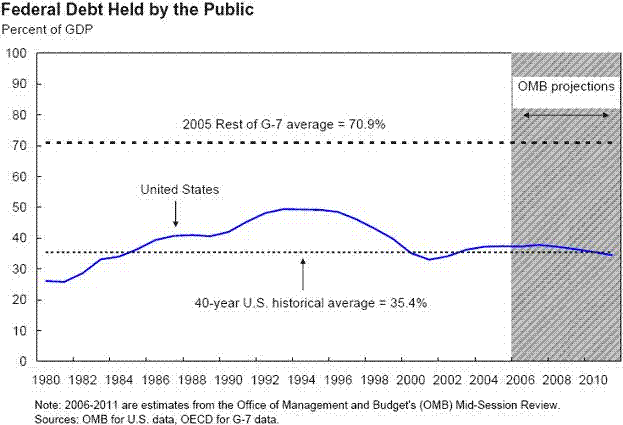
Here is a good graph from yesterday's congressional testimony of CEA chair Eddie Lazear (click on the graph to enlarge). The bottom line: The level of U.S. government debt, either now or in the near future, is not unusually high by historical or international standards.

The looming problem with fiscal policy is the longer-term outlook, which will unfold over the next several decades as the baby-boom generation retires and starts collecting Social Security and Medicare. At that point, this series will start rising rapidly unless taxes are raised or spending is reduced compared with benefits promised under current law.

Thursday, September 28, 2006

OPEC for Spuds

A reader alerts me to a textbook example of a cartel:

It took farmer Merrill Hanny three days to bury $100,000 worth of his perfectly good potatoes. He remembers how they crunched beneath his tractor as he plowed over his muddy field in the spring of last year.

Mr. Hanny destroyed part of his crop at the behest of the United Potato Growers of America, a fledgling group of regional farming cooperatives. The group aspires to be to potatoes what OPEC is to oil by carefully managing supply to keep demand high and constant, resulting in a more stable return for farmers.

The new organization has been a boon to Mr. Hanny, 53 years old, and other farmers who for years have watched potato overproduction push down prices and mash profits. "For the first time, I feel in control of my destiny," says Mr. Hanny, who is married and has seven children....

In the past year, United Potato helped erase 6.8 million hundred-pound potato sacks from the U.S. and Canadian markets -- the equivalent of about 1.3 billion medium orders of french fries at McDonald's. For farmers, their open-market returns surged to $10.04 per hundred pounds, up 48.5% from last year....

The spud cartel's manipulation of supply is perfectly legal. Orange, dairy and other farmers have employed similar co-ops as market stabilizers since 1922, when the Capper-Volstead Act exempted farmers from federal antitrust laws, permitting them to share prices and orchestrate supply.

From the Wall Street Journal two days ago. As a matter of public policy, it is hard to see any good reason to allow this cartel while outlawing most others.

But I must admit that it is hard for me to separate my objective analysis as an economist from my love of hash browns. So I have two reasons to object to this particular cartel.

Update: A comment draws attention to an odd phrase in the article: "managing supply to keep demand high and constant." This makes no sense if the words are interpreted as we use them in economics textbooks. Managing supply does not affect the demand curve. By "demand," the author probably meant "consumer expenditure," which in turn equals producer revenue.

Economics Nobel Prize Pool

Think you know who's going to win the Nobel prize in economics? Have a dollar you can afford to lose? If you answered "yes" to both questions, then contact Harvard grad student John Friedman.

Best line I heard today

"In Washington, the truth is just another special interest, and one that is not particularly well financed."

Attributed to Mike Mussa.

Update: A reader sends me the reference: Mussa, AER, May 1993.

Wednesday, September 27, 2006

I need to calm down

It really pisses me off when people confuse correlation with causation. Here is what I just read in the Harvard University Gazette:

Researchers at Johns Hopkins School of Medicine tracked 1,055 medical students for 36 years. Compared with cooler heads, the hotheads were six times more likely to suffer heart attacks by age 55 and three times more likely to develop any form of heart or blood vessel disease.

The conclusion is clear: Anger is bad for you at any age.

No, the conclusion from the fact given is not at all clear. People who get mad more easily do so for a reason--a more stressful job, bad genes, or some other mysterious factor X. Maybe it is the X factor, rather than the anger itself, that is bad for you. Maybe reducing anger without changing X won't change health outcomes at all.

I am going to call the author and give him a piece of my mind. Just as soon as this pain in my chest goes away.

Who invented supply and demand?

A blog reader emails me:

Hi-

I'm a devoted reader of your blog, and I use your textbook with the Boston Public School seniors whom I teach in Brighton. They love your book. Thanks for doing it!

Today in class, they asked two great questions that I couldn't answer, so I turn to...

Question 1. Who invented the supply and demand graph? (I said Heilbroner. Is that right?) 1B. What is there to read about the history of the graph itself? That is, when was it created? By whom? Was it adopted immediately? etc.

Question 2. Why is quantity on the X axis? Shouldn't it be on the Y axis?

Thanks again for all you do,

[name withheld]
Public School Econ teacher

The model dates long before Heilbroner. Here is the answer according to Wikipedia:
the partial equilibrium supply and demand economic model [was] originally developed by Antoine Augustin Cournot (published in a book in 1838) and thirty years later broadly publicized by Alfred Marshall.
That sounds right to me. I should note that Marshall's 1890 text was the standard for its day. You can find Marshall online, but unfortunately the online version omits the footnotes. In quickly looking through the copy I have on my shelf, I found supply-and-demand graphs in footnotes, but none in the main text. You can, however, read the discussion of supply and demand in Book V.

On the axis question: The instructor is right that, given the way we now teach supply and demand, it makes more sense to have price on the horizontal axis. The price is viewed as the variable that determines quantity supplied and quantity demanded, and we usually put the dependent variable (which here is quantity) on the vertical axis.

So why is it switched? Here is a guess. The early economists may have been imagining that, in the very short run, a given quantity of goods was supplied to the market (an agricultural harvest, for example). The supply curve is then vertical, and the price adjusts to ensure that quantity demanded equals this exogenous quantity supplied. So, in this very short run, the price seems more like the dependent variable. Now, however, the choice of axes is based more on historical convention than logic.

I am not an historian of economic thought, so these answers may be off base. But I am sure the commenters will correct me if I am mistaken.

Update: A comment directs us to a good article on the topic from the Richmond Fed.

Update 2: My Harvard colleague Robert Barro emails me his insights on the matter:
As I recall, Hicks in Value and Capital thought in terms of demand price and supply price. The demand price is how much a person was willing to pay for an additional unit of goods (starting from some initial quantity, Q). The supply price is how much a producer would have to be paid to provide an additional unit of goods. This construction--which I think comes from Marshall--makes it natural to have P on the vertical axis and Q on the horizontal.

Leonhardt on Cutler and Health Care

In today's NY Times, David Leonhardt highlights the work of Harvard health economics guru David Cutler. The bottom line:
an affluent society should devote an ever-growing share of its resources to the health of its citizens.
Cutler will be giving an ec 10 lecture later this semester.

Tuesday, September 26, 2006

Kremer on Immigration

My Harvard colleague Michael Kremer defends immigration. Here is a brief description of his new paper:

Immigrant workers serving as nannies, caretakers and housecleaners may be helping to improve conditions for native workers. A new paper, co-authored by a Harvard professor and a recent PhD graduate, concludes that the growing trend of immigrant household laborers is having the effect of raising salaries for native low-skilled workers, and reducing wage inequalities between workers overall.

The working paper titled “The Globalization of Household Production,” challenges many existing theories about the economic impacts of immigration. Co-authors Michael Kremer and Stanley Watt examine how immigrant household workers are affecting other labor trends, and how those trends are affecting the overall economy.

The authors document the rising numbers of women who are increasingly crossing international borders to work as private household workers. In Singapore and Hong Kong, for instance, foreign workers in private households comprise around 7% of the total labor force or more. The percentages are even higher in some “new rich” gulf countries.

Kremer and Watt argue that as more immigrant women serve in household positions, more high-skilled native women are therefore available to join the labor market, driving down relative wages among high-skilled workers and reducing the disparity in wages between low- and high-skilled workers. In addition, Kremer and Watt contend that as more native women return to the workforce, they contribute more tax dollars to the general coffers. This provides “a fiscal benefit for the population, even without considering the taxes paid by the migrants themselves,” they write. Assuming immigration levels of 7% of the total labor force, relative wages of native low-skilled workers are increased by 3.9%, and native welfare overall is increased by 1.2%, they claim.

Congratulations, Phill

President Bush today announced the nomination of Phillip Swagel to be Assistant Secretary of Treasury for Economic Policy. A graduate of Princeton and the Harvard PhD program in economics, Phill was my chief of staff at the CEA and, most recently, a coauthor of mine on papers on antidumping and outsourcing.

A great choice for an important job.

The Omnipotent POTUS

Some Americans don't understand the limits of Presidential power in a market economy:
According to a new Gallup poll, 42 percent of respondents agreed with the statement that the Bush administration "deliberately manipulated the price of gasoline so that it would decrease before this fall's elections."...Almost two-thirds of those who suspect President Bush intervened to bring down energy prices before Election Day are registered Democrats, according to Gallup.
From yesterday's Washington Post.

I take this as further evidence that we need better and more widespread economics education.

Stiglitz on GDP

Economist Joe Stiglitz, writing in Fortune magazine, takes aim at Gross Domestic Product as a measure of how well an economy is doing. He prefers Green Net National Product to take into account (1) degradation of the environment and use of natural resources, (2) depreciation, and (3) payments to foreigners.

I won't argue the points, but they seem somewhat pedantic to me (even as a fellow pedant). I bet these two measures are highly correlated over time and across countries, so for most purposes the distinction is not crucial. Moreover, I doubt focusing on the wrong measure has really lead to any significant policy blunders. No politician wakes up in the morning and says, "Today, I am going to maximize GDP as measured by my national income accountants."

LifeAtHarvard.com

Here is a brand new blog, apparently written by a few Harvard undergrads, which might interest some readers here, especially the post Economics: the biggest, baddest major at Harvard.

I already learned something about the school I didn't know after teaching here for 21 years: We have waffles with the school seal.

Monday, September 25, 2006

Nouriel goes out on a limb

Nouriel Roubini, an econ professor at NYU, talks to New York Magazine about the housing market:

Will there be a fire sale in the city?

I’d expect prices to be 5 to 10 percent lower a year from now, on average. On the national level, real home prices may fall 20 to 30 percent.

Good news for affordable-housing advocates.

Robert Mundell

Here is a nice piece on economist Robert Mundell, a pioneer in international finance, whose work is highlighted in Chapter 12 of my intermediate macroeconomics text.

How to Make $1 Billion

In today's Washington Post, Sebastian Mallaby says we should get rid of the penny (I agree), and he estimates the value of this long-overdue reform:
the National Association of Convenience Stores and the Walgreens drugstore chain have estimated that handling pennies adds 2 to 2.5 seconds per cash transaction. Assume that the average citizen makes one such transaction every day, and so wastes (to be conservative) 730 seconds a year. The median worker earns just over $36,000 a year, or about 0.5 cents per second, so futzing with pennies costs him $3.65 annually.
Multiply that last figure by the number of Americans, and you find that getting rid of the penny would free up economic resources valued at about $1 billion a year.

Hume vs Schumer and Graham

Here is a good question for an exam in international economics:

"One of the fundamental tenets of free trade is that currencies should float -- or at the very least, move along with market forces." True or False? Explain.
The quotation is from an op-ed in today's Wall Street Journal by Senators Charles Schumer and Lindsey Graham, writing about their plan to slap tariffs on Chinese goods unless the Chinese let the yuan move in foreign-exchange markets.

My answer would start by saying that the quoted statement is false. There is nothing inconsistent between free trade and fixed exchange rates.

My explanation would emphasize David Hume's price-specie flow mechanism. Back in the 18th century, Hume studied how the world economy reaches equilibrium under the fixed exchange rates established by a world gold standard. In such a system, adjustments in the price levels at home and abroad were the mechanism that brought trade flows into equilibrium. As a result of automatic adjustments in money supplies and prices, fixed exchange rates between currencies can coincide with free trade in goods and services.

Here is a question for the Senators to ponder: How do New York and South Carolina manage to have free trade between them? There is no floating exchange rate to bring interstate trade flows into equilibrium. By using a common currency, the two states effectively have a fixed exchange rate, and somehow everything works out just fine. David Hume explained why.

Or maybe the Senators want to slap tariffs on interstate purchases until each of their states adopts its own freely floating currency. There's a topic for their next op-ed.

For previous posts on the Chinese exchange rate, click here and here.

Sunday, September 24, 2006

Truthiness

It is always fascinating to hear when "facts" turn out to be otherwise. Here is a "fact" from psychiatrist Louann Brizendine, author of the best-selling new book The Female Brain:
A woman uses 20,000 words per day, while a man uses only 7,000.
That is an amazing "fact," and I remember being quite struck by it when I first read it several weeks ago in an article on Brizendine.

But is it true? In today's Boston Globe, Mark Liberman, a Professor of Phonetics at the University of Pennsylvania, says that this "fact" has no hard data to back it up:
As it happens, there are many scientific studies that count the words used by females and males.... The findings? According to a 1993 review of the scientific literature by researchers Deborah James and Janice Drakich, ``Most studies reported either that men talked more than women, either overall or in some circumstances, or that there was no difference between the genders in amount of talk."
Liberman says Brizendine's "fact" is urban legend. Is he right? I have no idea. But one of them must be wrong.

Before readers tell me this post has nothing to do with economics, let me beg to differ. There is a lesson here: Be ready to question all "facts" you read, including those coming from economists. Don't believe everything you find in books and newspapers, or even on your favorite blog.

Update: A reliable source tells me that this "fact" is indeed wrong and that the book will be corrected. He describes Brizendine as "a pretty responsible scientist who lept at a few things which seemed to quantify her basic thesis in journalistic shorthand."

Ferguson Interview

The "Ideas" section of today's Boston Globe interviews Harvard historian Niall Ferguson. An excerpt:

IDEAS: But you supported the invasion of Iraq.

FERGUSON: I argued that if it was to be done, it should be done well or not at all. But I didn't oppose it. With the benefit of hindsight, I regret that. It was a disaster to commit so few troops and to have no coherent plan for reconstruction. It was in defiance not only of British imperial history but of successful American occupations--for example of Germany, Japan, and Korea, where the United States stayed long enough to change institutions. But typically, American interventions last only a few years. In the case of the Middle East, the result will be turning Iraq into a Haiti on the Tigris.

IDEAS: How do you understand radical Islamism? Is it, as some say, the successor to Marxism?

FERGUSON: It is. The great category error of our time is to equate radical Islamism with fascism. If you actually read what Osama bin Laden says, it's clearly Lenin plus the Koran. It's internationalist, revolutionary, and anticapitalist--rhetoric far more of the left than of the right. And radical Islamism is good at recruiting within our society, within western society generally. In western Europe, to an extent people underestimate here, the appeal of radical Islamism extends beyond Muslim communities.

IDEAS: To people who might once have been drawn to Marxism?

FERGUSON: And for much the same reason. Here is a way to reject the impure, corrupt qualities of western life and embrace a monotheistic zealotry.

New Book on Adam Smith

We have been talking about Adam Smith in ec 10. So it is timely that I now learn about a new biography of him. Tim Worstall reviews the book by James Buchan in today's Philadelphia Inquirer. Here is an excerpt from the review:

The Authentic Adam Smith

Here is a quite delightful little introduction to the life, times and work of Adam Smith. We are reminded early on that the Smith we think we know, lauded as the ultimate free marketeer, was in fact a philosopher seeking the eternal verities, not just doing the vulgar calculations of business and markets....

Buchan places Smith, as he was, firmly at the heart of the Scottish Enlightenment. In addition to his great friend David Hume, he knew James Watt the engineer, and was a childhood friend of Robert Adam, who did so much to create Bath and thus influence the Edinburgh New Town. He taught at the University of Glasgow and became a professor there in 1752.

The first of Smith's two major works, The Theory of Moral Sentiments, appeared in 1759, and Buchan not only takes us through the book's main points but also provides us with the background to the debates within it -- where an argument came from, and how it was answering or developing a point proffered by another.

We are also given a series of more personal details about Smith that help us to understand the man himself. Certainly he was of the utmost probity concerning money: In 1764 he became tutor to the young Duke of Buccleugh for the, at the time, remarkable fee of 300 pounds a year and a pension of the same for life after three years. On leaving the university, Smith insisted on returning the lecture fees to his students, and when they protested, "seizing by the coat the young man... he thrust the money into his pocket, and then pushed him from him."...

The value of this book is in precisely those moments and pieces of background. There will be those who have only heard of Smith as the intellectual basis for some assumed free market economic methods, but he was far more subtle than that. Both of his great works are mentioned and discussed, the above Theory and of course The Wealth of Nations. But, by placing him in his time, discussing the surrounding debates and events, Buchan is able to make a much more important point. Smith was not, in fact, attempting to provide a moral basis for a specific form of economic organization, in the way that perhaps Marx was a century later. Rather, he was interested in morals first; the economic thoughts grew from his research into them.

Saturday, September 23, 2006

Yale, gratis

CNN reports that some Yale courses will be made available online for free:

Yale University said on Wednesday it will offer digital videos of some courses on the Internet for free, along with transcripts in several languages, in an effort to make the elite private school more accessible.

While Princeton University, Massachusetts Institute of Technology and others already offer course material online without charge, Yale is the first to focus on free video lectures, the New Haven, Connecticut-based school said.

The 18-month pilot project will provide videos, syllabi and transcripts for seven courses beginning in the 2007 academic year. They include "Introduction to the Old Testament," "Fundamentals of Physics" and "Introduction to Political Philosophy."

Might this news mark the beginning of a big change in the industrial organization of higher education?

Zeroing

Bloomberg reports, EU Renews WTO Complaint Over U.S. `Zeroing' Practice. Zeroing refers to the bizarre method of calculating antidumping duties--a method that has no basis in economic theory or common sense and that serves as yet another barrier to trade.

Here is how Phill Swagel and I described zeroing in our paper on antidumping:

One ongoing dispute concerns the U.S. practice of “zeroing,” which allows officials to disregard instances in which foreign firms charge prices over fair value, thus offsetting supposed instances of undercharging. Consider, for example, a foreign firm that sells a product in its home and U.S. markets. Six months a year, the firm charges $10 in its home market and $8 in the United States; the other six months a year, it charges $8 at home and $10 in the United States. On average, the firm charges $9 both overseas and in the United States. But under zeroing, a U.S. official can define this as dumping, with each sale in the first half of the year assigned a dumping margin of $2 and each sale in the second assigned a dumping margin of zero (rather than -$2). Instead of letting the overpricing offset the underpricing, which would mean no tariff, the average
dumping margin—and the resulting tariff—is $1.

Europe’s version of zeroing was recently found to be contrary to its WTO obligations.The U.S. government has asserted that its version differs from the Europeans’ and is attempting to defend its practice before the WTO. The WTO is unlikely to accept Washington’s defense, hinting at yet another defeat for the United States in the WTO dispute process.

This is an international dispute the United States deserves to lose.

Comments Policy

October 2007 Update: The rules below proved too costly to enforce once the readership of the blog expanded. As a result, comments are no longer enabled. Feel free to email me any comments you might have.

-----

A prominent economist emails me some comments on a previous post, with the following preface:

I do not feel like responding on the site. It feels like shouting in a crowded room.
This got me to rethink my comments policy. In the past, I have deleted only a very few comments that readers have posted. But I think it may be time to turn down the volume of the shouting in order to raise the level of the discussion.

Here is my new policy: Anyone is free to disagree with me, or with other commenters, as long as it is done politely. Comments that take a belligerent approach to economic debate are at risk of being deleted.

Please approach this blog with the civility you would bring to a college seminar. Don't post anything here that you wouldn't say to a fellow seminar participant face to face.

Update: One more rule, which perhaps goes without saying: Any post that aims to promote specific commercial products--or, God forbid, competing textbooks!--will be promptly deleted as well.

Ip is caught framing

In today's Wall Street Journal, Greg Ip describes recent changes in tax rates:
The data show that the average tax rate for all taxpayers was 12.1% [in 2004], up slightly from 11.9% in 2003 but down from 15.3% in 2000, due in part to the Bush tax cuts. Rates fell most for those at the top. The tax rate of the richest 1% fell to 23.5% from 24.3% in 2003 and 27.5% in 2000. For the bottom 50%, the 2004 tax rate was 3%, unchanged from 2003 and down from 4.6% in 2000.
The sentence that I have bolded puts a particular spin on the numbers. Here is an alternative way to describe the changes:
From 2000 to 2004, the average tax rate for all taxpayers fell from 15.3% to 12.1%, representing 21% tax cut. The tax rate of the richest 1% fell from 27.5% to 23.5%, a 15% tax cut. For the bottom 50%, the tax rate fell from 4.6% to 3%, a 35% tax cut. As a result of these changes, the top 1% paid a larger share of the tax burden in 2004 than it did four years earlier, and the bottom 50 percent paid a smaller share.
Isn't it amazing how the same set of numbers can be framed in different ways?

The reporters at the Journal, including Greg Ip, are among the best in the business and are usually good about keeping their own political views out of their news stories. This is an exception. By choosing the particular framing that he did, Ip let his politics seep into his reporting.

To be clear, I am not suggesting that the second description is neutral and better. I offer it to illustrate how the same numbers can be seen in a different light. If Ip had cut the sentence that I put in bold and just presented the facts, his paragraph would have conveyed the same information without any spin.

Friday, September 22, 2006

The Boys from Belarus

Here is a nice profile of MIT's Mikhail Golosov and Harvard's Aleh Tsyvinski, two young hotshots working at the boundary of macroeconomics and public finance. (Note to Harvard students: Tsyvinski will teach Ec 1011b this spring.)

Immigration and African-Americans

Of all the economists I know, George Borjas of Harvard's Kennedy School is the one most critical of proposals to relax immigration restrictions, such as President Bush's proposed guest worker program. Here is a new paper of his that could potentially have a big impact in the immigration debate:

Immigration and African-American Employment Opportunities: The Response of Wages, Employment, and Incarceration to Labor Supply Shocks
by George J. Borjas, Jeffrey Grogger, Gordon H. Hanson

The employment rate of black men, and particularly of low-skill black men, fell precipitously from 1960 to 2000. At the same time, the incarceration rate of black men rose markedly. This paper examines the relation between immigration and these trends in black employment and incarceration. Using data drawn from the 1960-2000 U.S. Censuses, we find a strong correlation between immigration, black wages, black employment rates, and black incarceration rates. As immigrants disproportionately increased the supply of workers in a particular skill group, the wage of black workers in that group fell, the employment rate declined, and the incarceration rate rose. Our analysis suggests that a 10-percent immigrant-induced increase in the supply of a particular skill group reduced the black wage by 3.6 percent, lowered the employment rate of black men by 2.4 percentage points, and increased the incarceration rate of blacks by almost a full percentage point.

Should Harvard undercut early decisions?

Dartmouth professor Andrew Samwick reports on his blog that Dartmouth is unlikely to follow Harvard (and now Princeton) in abolishing its early decision program. If this is a sign of what other, similar schools will do, it could make Harvard's recent policy change less tenable. Some strong but risk-averse students might apply to Dartmouth, Columbia, Brown, etc., forgoing the chance to apply to Harvard in order to get the advantage of an early application. If Harvard starts losing too many good applicants in this way, it will have to rethink its position.

Harvard could, however, become the catalyst for systemic change: It could decide to stop honoring early decision commitments to other schools. In this case, a student could get into Dartmouth early, secretly apply to Harvard, and then renege on his Dartmouth commitment if accepted by Harvard. A few years ago, it was rumored that Harvard was considering just that.

There are pros and cons to Harvard taking such a radical step. The arguments against:
  • Harvard would be encouraging students to break promises.
  • The Harvard student body would be disproportionately made up of dishonest students.
On the other hand:
  • By undermining early decisions at other schools, Harvard would give a big push toward changing a system that many educators view as adverse for high-school students.
  • Harvard would be able to accept a greater proportion of the best students.
  • As a general matter, Harvard does not enforce contracts between its students and third parties. Why should Dartmouth be different?

Ideally, Harvard could avoid having to make the choice. If schools such as Dartmouth started worrying that Harvard was considering such a drastic step, maybe that fear alone would be enough to get them to change course and abolish their early decision programs.

But what might induce Dartmouth to fear this possibility? Maybe, if some Harvard faculty member speculated about it on his blog,....

Thursday, September 21, 2006

Legacy Admits

Daniel Hemel of the Harvard Crimson reviews "The Price of Admissions: How America’s Ruling Class Buys Its Way into Elite Colleges—and Who Gets Left Outside the Gates" by Daniel Golden. Hemel, who is not a legacy, defends preferential treatment for alums and the wealthy. An excerpt:

For instance, in 1996, Harvard admitted an applicant named Anne Chandler Bass “in the hope of favors yet to come” from her father, a Yale-educated oil magnate. When Anne Chandler Bass graduated in 2000, her father donated $7 million to Harvard—a gift that now pays the salary of Bass Professor of Government Michael J. Sandel. (The delicious irony—which goes unmentioned by Golden—is that this apparently-unjust admissions break is the source of the funding that facilitates Sandel’s wildly-popular course “Justice.”)

My Role Model

As an undergraduate, I loved Albert Camus's The Myth of Sisyphus (an assignment in a freshman philosophy class taught by Richard Rorty). So I was particularly pleased to read this over at Economic Investigations:
Prof. Mankiw is like Sisyphus, doomed for eternity to point out to people that they—including the state—face trade-offs.
I have finally found my calling.

Lively Levitt Lecture

University of Chicago economist Steve Levitt, coauthor of Freakonomics, gives a great talk describing the research he has done on crack cocaine and the lives of gang members.

Rosling on Health and Wealth

A reader alerts me to an illuminating and entertaining presentation by Swedish professor Hans Rosling on international health and economic development. It takes a few minutes but is well worth the time, especially for students unfamilar with the data on these topics.

Rogoff on the IMF

My Harvard colleague Ken Rogoff, formerly chief economist at the International Monetary Fund, writes in the new issue of Newsweek Who Needs the IMF?

Inequality Trends

In my ec 10 lecture yesterday, I said that while income inequality has increased in the United States over the past several decades, it has decreased in the world as a whole. A student in the class emails me a good question about this claim:

Professor Mankiw

With all due respect, I cannot find peace with your assertion today that the world is becoming 'more equal'. I just read this in one of my other lecture notes: 'Though Africa has historically been poor the difference between it and the restof the world has dramatically increased in the last 200 years. In 1800, per-capita income in the US was possibly 3 times greater than in Africa. Now itis 20 times greater. Compared to the poorest African countries it might be 50 or 60 times greater.'

I would really appreciate some feedback on this matter. Of course I understand how busy you must be so please do not let this be an inconvenience to you.

Sincerely,
[name withheld]
South Africa

As the student notes, Africa is indeed lagging behind. The decline in world inequality is driven by the experiences of India and especially China, rapidly growing countries with large numbers of poor people.

Here is an excerpt from a research paper by Columbia University economist Xavier Sala-i-Martin:

All indexes show a reduction in global income inequality between 1980 and 1998. We also find that most global disparities can be accounted for by across-country, not within-country, inequalities. Within-country disparities have increased slightly during the sample period, but not nearly enough to offset the substantial reduction in across-country disparities. The across-country reductions in inequality are driven mainly, but not fully, by the large growth rate of the incomes of the 1.2 billion Chinese citizens.

Unless Africa starts growing in the near future, we project that income inequalities will start rising again. If Africa does not start growing, then China, India, the OECD and the rest of middle-income and rich countries diverge away from it, and global inequality will rise. Thus, the aggregate GDP growth of the African continent should be the priority of anyone concerned with increasing global income inequality.

Here is another paper on the African growth experience. See also page 435 of your textbook, where you will find a box on global inequality (new in the 4th edition).

Wednesday, September 20, 2006

Interview with Marty

The Minneapolis Fed interviews Martin Feldstein, my Harvard colleague and predecessor as head of Ec 10.

CBO on Global Warming

A just-released report from the Congressional Budget Office takes on global warming, framing the issue in a way that should be familiar to Ec 10 students. CBO points to a negative externality from carbon emissions and a positive externality from research. An excerpt:

The possibility of climate change involves two distinct “market failures” that prevent unregulated markets from achieving the appropriate balance between fossil fuel use and changes in climate. One market failure involves the external effects of emissions from the combustion of fossil fuels—that is, the costs that are imposed on society by the use of fossil fuels but that are not reflected in the prices paid for them. The other market failure is a general underinvestment in research and development (R&D) that occurs because investments in innovation may yield “spillover” benefits to society that do not translate into profits for the innovating firm. The first market failure yields inefficiently high use of fossil fuels; the second yields inefficiently low R&D.

Because there are two separate market failures, an efficient response is likely to involve two separate types of policies:

  • One type of policy would reduce carbon emissions by increasing the costs of emitting carbon, both in the near term and in the future, to reflect the damages that those emissions are expected to cause.
  • The other type of policy would increase federal support for R&D on various technologies that could help restrain the growth of carbon emissions and would create spillover benefits.

Policymakers could increase the cost of emitting carbon by setting a price on those emissions. That could be accomplished by taxing fossil fuels in proportion to their carbon content (which is released when the fuels are burned) or by establishing a “cap-and-trade” program under which policymakers would set an overall cap on emissions but allow fossil fuel suppliers to trade rights (called allowances) to those limited emissions. Either a tax or a cap-and-trade program would cause the prices of goods and services to rise to reflect the amount of carbon emitted as a result of their consumption. To the extent that a carbon tax or allowance price reflected the present value of expected damages, such policies would encourage users of fossil fuels to account for the costs they impose on others through their emissions of greenhouse gases.

It sounds like the CBO is angling for admission into the Pigou Club.

A Few Fun Readings for Ec 10

Here is the link to I, Pencil, the essay I discussed in today's ec 10 lecture. On price gouging and its defense, here is legal scholar Richard Posner and economist Gary Becker. And here is the defense of Scrooge that I mentioned.

Note: Readings I recommend on this blog are optional, unless they also appear on the official Harvard course website.

Sugar Ethanol

In today's NY Times, columnist Tom Friedman arrives at the intersection of energy, farm, and trade policy and doesn't like what he finds:
Thanks to pressure from Midwest farmers and agribusinesses, who want to protect the U.S. corn ethanol industry from competition from Brazilian sugar ethanol, we have imposed a stiff tariff to keep it out. We do this even though Brazilian sugar ethanol provides eight times the energy of the fossil fuel used to make it, while American corn ethanol provides only 1.3 times the energy of the fossil fuel used to make it. We do this even though sugar ethanol reduces greenhouses gases more than corn ethanol. And we do this even though sugar cane ethanol can easily be grown in poor tropical countries in Africa or the Caribbean, and could actually help alleviate their poverty.
Friedman calls this state of affairs "stupid." This is a word I usually avoid (for it is hard to use politely), but it does seem particularly apt here.

The Demographic Challenge


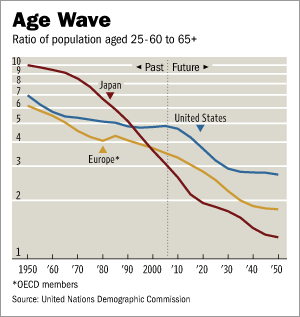
In today's Wall Street Journal, economist Jeremy Siegel looks at the demographic trends, as shown in the graph above, and concludes that Americans need to retire later:

When Social Security was passed in 1935, the average retirement age was 69. That age fell to 67 by 1950, and to 62 today....

Because of our aging population, I calculate that the average retirement age will have to rise by 10 years or more for workers to produce enough goods and services to provide for a comfortable retirement. This increase will greatly exceed the expected increase in life expectancy and lead -- for the first time in history -- to an absolute reduction in the number of years in retirement.

Siegel also suggests that one way to finance the baby boomers' retirement is persistent capital inflows and trade deficits with developing countries.

Tuesday, September 19, 2006

Predicting the Nobel Prize

Thomson Scientific forecasts the 2006 Nobel Prize in Economics.

TNR on Outsourcing

A blog reader asks me about an article in the new issue of The New Republic, in which Clay Risen reports that he has read my paper with Phillip Swagel (published version) on offshore outsourcing.

Risen concludes that "ultimately, Mankiw and others are right--we really are better off, in the long run, with freer trade." But he calls us "cynical" for wanting to frame the issue in terms that non-economists can more easily understand. Risen's preferred solution is an expansion in the generosity of the social safety net: more generous unemployment insurance, wage insurance for displaced workers, more spending on worker retraining, and national health insurance.

Unfortunately, he throws out these ideas as cliches without addressing the hard tradeoffs they entail. Higher unemployment-insurance benefits may reduce risk but they affect the search effort of the unemployed and increase unemployment. Wage insurance raises a question of equity: Does someone who loses a high-wage job and takes a low-wage job deserve greater government benefits than a low-wage worker who never had a high-wage job? Worker retraining programs should pass a cost-benefit test, and the evidence, at least for older workers, is not encouraging. National health insurance raises a whole host of difficult issues that health economists debate and that have little to do with offshore outsourcing. Whatever you think about national health insurance, the outsourcing of some call centers to India probably shouldn't change your mind.

So, overall, I was not impressed by Risen's piece. But at least he spelled my name right.

The Rich, Redux

In a post last week, I asked, "Who are the very rich who are making out so well?" In response, Steve Kaplan of the University of Chicago emails me a new paper of his that starts to answer this question. Here is the abstract:

We consider how much of the top end of the income distribution can be attributed to four sectors – top executives of non-financial firms (Main Street); financial service sector employees from investment banks, hedge funds, private equity funds, and mutual funds (Wall Street); corporate lawyers; and professional athletes and celebrities. Non-financial public company CEOs and top executives do not represent more than 8% of any of the top AGI brackets (the top 0.1%, 0.01%, 0.001%, and 0.0001%). Individuals in the Wall Street category comprise at least as high a percentage of the top AGI brackets as non-financial executives of public companies. While the representation of top executives in the top AGI brackets has increased from 1994 to 2004, the representation of Wall Street has likely increased even more. While the groups we study represent a substantial portion of the top income groups, they miss a large number of high-earning individuals. We conclude by considering how our results inform different explanations for the increased skewness at the top end of the distribution. We argue the evidence is most consistent with theories of superstars, skill biased technological change, greater scale and their interaction.
The last sentence seems broadly consistent with the view David Brooks has been advocating in his NY Times column.

The paper also claims that because the groups studied make up well under half of the top income group, the results are "strongly inconsistent with the claim in Dew-Becker and Gordon (2005) that CEOs, celebrities, and athletes explain most of the top end of the distribution."

Milken on the World Economy


In today's Wall Street Journal, Michael Milken points out:
China and India combined to produce nearly half the world's economic output in 1820 compared to just 1.8% for the U.S. Our remarkable growth since 1820 has benefited from democratic institutions, a belief in capitalism, private property rights, an entrepreneurial culture, abundant resources, openness to foreign investment, the best universities, immigration and relatively transparent markets.
That graph is truly striking.

Monday, September 18, 2006

What's New in 4e?

Today, after my ec 10 lecture, a student asked me: Is the 4th edition of my Principles of Economics textbook substantially different from the 3rd edition?

As an answer, let me offer an excerpt from the preface to the 4th edition:

Although the principles of economics are timeless, the application of those principles changes over time as events unfold and as policymakers consider new initiatives. To keep the study of economics fresh and relevant for each new cohort of students, teachers of economics must constantly update their courses. This new edition contributes to that effort by including dozens of new case studies and boxes.

The new features in this edition are too numerous to list in their entirety, but here is a sample:

  • A new box describes how football coach Bill Belichick has used economic research to improve his team’s 4th-down strategy.
  • A new box summarizes recent research by Nobel prize winner Ed Prescott on how taxes influence work effort in Europe.
  • A new box discusses the winners and losers from the increased textile trade with China.
  • A new box considers the economics of offshore outsourcing.
  • A new case study describes the fiscal challenge ahead that arises from an aging population.
  • A new box describes how London has reduced congestion with road pricing.
  • A new box discusses how rapid growth in Asia is making the global distribution of income more equal.
  • A new box summarizes recent research into the causes of child labor in poor nations.
  • A new case study examines the moral hazard problem as applied to corporate managers.
  • A new box discusses what behavioral economics says about the determinants of saving.
  • A new box considers how economic statistics can miss the underground economy.
  • A new box uses three striking photos to illustrate the differences in living standards in Great Britain, Mexico, and Ethiopia.
  • A new box includes an article by the presidents of Mali and Burkina Faso on how freer world trade would benefit their nations’ poor farmers.
  • A new box examines some of the peculiar features of U.S. health insurance.
  • A new box discusses the problem of high unemployment in Germany.
  • A new case study considers whether the U.S. economy could ever experience a bout of capital flight.
  • Two new boxes analyze the economics of Hurricane Katrina—one focusing on the short-run macroeconomic impact and the second on the reconstruction effort.
  • And finally, a new case study in Chapter 2 discusses my own recent experience as an economic adviser to President Bush.

In addition to updating the book, I have refined its coverage and pedagogy with input from many users of the previous edition. There are many changes, both large and small, aimed at making the book clearer and more student-friendly.

Ivy League CEOs

Today's Wall Street Journal reports that American business is not elitist:

'Any College Will Do'

The college diplomas of the nation's top executives tell an intriguing story: Getting to the corner office has more to do with leadership talent and a drive for success than it does with having an undergraduate degree from a prestigious university.

Most CEOs of the biggest corporations didn't attend Ivy League or other highly selective colleges. They went to state universities, big and small, or to less-known private colleges....

Some 10% of CEOs currently heading the top 500 companies received undergraduate degrees from Ivy League colleges, according to a survey by executive recruiter Spencer Stuart. But more received their undergraduate degrees from the University of Wisconsin than from Harvard, the most represented Ivy school [with 9 CEOs].

Interesting spin. You could turn the numbers around and tell a different story. My very rough guess is that about 1 percent of college graduates have degrees from Ivy League schools. So that 10-percent figure means that an Ivy League graduate is about ten times more likely to become a CEO than is an average college graduate.

Of course, the better chances for the Ivy League grad are largely a selection effect rather than a treatment effect, as discussed in this old article by Alan Krueger.

Milton and Me


That's me on the left, as explained in this email I received this morning:

Professor Mankiw,

I'm a economics student at the University of Illinois in Champaign-Urbana. I'm a huge fan of yours. I'm starting the graduate school application process and I enjoy your blog posts for students interested in pursuing Ph.D.s in economics. Heeding your advice,I've enrolled in more advanced mathematics courses than any senior in college would ever want to stomach.

This is going to sound a little weird, but I assure you I'm not totally crazy. I was adding a new fish to my fish tank and I was trying to come up with the perfect name for him. His tankmate is already named Milton Friedman, and because I have a soft spot for free market economists I thought the best name for my new little friend would be Mankiw. I've attached a photo of your marine namesake. He's the yellow angelfish, and Milton Friedman is the blue and orange gourami. I hope you enjoy that your name will be immortalized... or, well, for as long as angelfish live.

Sincerely,
[name withheld]

What a great way to start a day!

Sunday, September 17, 2006

Peers Matter

Peer effects are a hot research topic.

According to a new working paper by Alexandre Mas and Enrico Moretti, a person works harder when he has hard-working peers:

Using scanner level data, we measure high frequency, worker-level productivity of checkers for a large grocery chain. Because of the firm's scheduling policy, the timing of within-day changes in personnel is unsystematic, a feature for which we find consistent support in the data. We find strong evidence of positive productivity spillovers from the introduction of highly productive personnel into a shift. A 10% increase in average co-worker permanent productivity is associated with 1.7% increase in a worker's effort.
According to a new working paper by Philip J. Cook, Robert MacCoun, Clara Muschkin, and Jacob Vigdor, whether sixth graders are grouped with younger kids in elementary school or older kids in middle school affects their behavior:

sixth grade students attending middle schools are much more likely to be cited for discipline problems than those attending elementary school....Furthermore, the higher infraction rates recorded by sixth graders who are placed in middle school persist at least through ninth grade. A plausible explanation is that sixth graders are at an especially impressionable age; in middle school, the exposure to older peers and the relative freedom from supervision have deleterious consequences.
To read about earlier work on peer effects, click here and here.

These results would not surprise Judith Rich Harris.

Good Academic, Bad Human Being

Mike Moffatt considers the question:
"What real world experiences should I have to be a good academic economist?"
He answers:
I'd say none. Academia, by necessity, is about focusing your concentrations on very isolated and unique problems. I've noticed the people who succeed in graduate school tend to have fewer outside interests to distract them from their focus, not more.
A lot of economics professors I know would agree with this answer. Indeed, I have heard similar advice given many times. But I am inclined toward a different judgment.

It all comes down to the definition of "good academic economist." If your goal is to maximize the probability of winning a Nobel prize, or at least to climb up as high as you can on citation rankings, then this advice is correct. Real world experiences and outside interests are a distraction. Don't take time off from academic pursuits for a job in public policy. Don't ever work on Wall Street or do any consulting. Don't engage in the broader societal debate by writing op-eds or working on political campaigns. All of that takes time away from getting papers published in academic journals.

But don't stop there. If you have this objective, then it is best not to have hobbies, or read novels, or go to the movies. Don't spend time teaching well or mentoring students, except the very best students who can help you with your research. Don't get married or have friends, unless your spouse and friends are PhD economists and can coauthor papers with you. Whatever you do, don't have children--boy, are they a time sink! And if you make the mistake of having children, make sure you spend as little time with them as you can.

In other words, if you want to be the best academic you can be, get ready to be a miserable human being.

Alternatively, you might decide that, at the end of your life, Saint Peter will not judge you solely by checking the Social Science Citation Index. If so, maybe you should make life choices using a broader objective function--one that encourages you to sacrifice some degree of academic success narrowly construed for a more diverse, more satisfying, and more noble life.

Saturday, September 16, 2006

How to Identify My Car

Grad Student Ambassadors

U.S. higher education is an export industry, with positive externalities:
one of the best ways the United States can improve its image abroad is to encourage more foreigners to spend a year or two in America. It is therefore heartening to see that, according to the Council on Graduate Schools, there has been a recovery in international students attending U.S. graduate schools: "First-time enrollment increased by 4% in 2005, the first increase in four years."
From Drezner at the Open University blog.

Ec 10 Review

The Harvard Crimson, the student newspaper, reviews Ec 10. An excerpt:

For many Harvard freshmen, Ec10 (aka, Social Analysis 10, “Principles of Economics,”) is as much a part of the college experience as sneaking food out of Annenberg. Sections will sometimes bore you to tears, yet this introductory economics survey is one of the most practical classes offered at the College. Besides knocking out the Social Analysis core and fulfilling a requirement for Economics and Social Studies concentrators, it teaches concepts that will seem so intuitive you’ll be embarrassed by how little you knew before taking the course. Not surprisingly, Ec10 attracts about a third of the freshman class from all walks of Harvard life: future investment bankers, undecided souls who are “thinking about Social Studies,” and, naturally, some stereotypical jocks....

Liberals criticize Ec10 as having a conservative bias and preaching a form of “free-market fundamentalism.” And it’s true that Mankiw—a former economic adviser to George W. Bush—did assign an article entitled “Two Cheers for Sweat Shops.” But hey, that’s economics, baby.
By the way, that article on sweat shops is by the well-known right-winger Nicholas Kristof.

Public Attitudes Toward Trade

The news is not good:
Shifts in domestic attitudes and world politics have combined to create one of the least hospitable environments for trade liberalization in recent memory. The most dramatic shift in opinion came from Americans making more than $100,000 a year. According to the Program on International Policy Attitudes (PIPA), support in that income group for promoting trade dropped to 28 percent in 2004 from 57 percent in 1999. A September 2005 German Marshall Fund (GMFUS) survey revealed that 57 percent believe that freer trade destroys more American jobs than it creates, and 58 percent of Americans would favor raising tariffs for imported goods if it meant protecting jobs -- a higher number than in Germany, France, or Great Britain.
From Daniel W. Drezner in the Washington Post.

The UN in a Nutshell

This is described as an "old quip," but it's new to me:
When there is a dispute between two small nations, the UN steps in and the dispute disappears. When there is a dispute between a small nation and a large nation, the UN steps in and the small nation disappears. When there is a dispute between two large nations, the UN disappears.
From Ken Rogoff, who suggests some parallels with the IMF.

Rogoff joins the Pigou Club

I am pleased to welcome my Harvard colleague Ken Rogoff into the Pigou Club. In his latest op-ed, he writes:

As for the US, a sharp hike in energy taxes on gasoline and other fossil fuels would not only help improve the government’s balance sheet, but it would also be a way to start addressing global warming. What better way for new US Treasury Secretary Hank Paulson, a card-carrying environmentalist, to make a dramatic entrance onto the world policy stage?

The Pigou Club is an elite group of economists and pundits with the good sense to have publicly advocated higher Pigovian taxes, such as gasoline taxes or carbon taxes. Here are some examples of the current membership:

We are always looking for more members. An elected official or two would be nice.

Update: Alan Greenspan signs up. So do George Schultz, Tony Lake, Nicholas Stern, Hal Varian, Larry Summers, Richard Posner, David Frum, Nouriel Roubini, Joe Stiglitz, Brink Lindsey, Tim Harford, Rob Stavins, Ray Magliozzi, Robert Samuelson, Dan McFadden, Charles Krauthammer, Paul Mulshine, Kevin Hassett, Jason Furman, Anne Applebaum, Paul Volcker, Bill Frenzel, Isabel V. Sawhill, Charles Stenholm, William Hoagland, Robert Shapiro, David Leonhardt, Morton Kondracke, Gilbert Metcalf, Fred Foldvary, Arthur Laffer, and a majority of economists.

Friday, September 15, 2006

Why Aspiring Economists Need Math

A student emails me a question about the use of math in economics:

Dear Dr. Mankiw,

Hi, I am an undergraduate student studying economics in Michigan. I have recently become a big fan of your blog. I found your "Advice for Students" very helpful to professional economist-wannabes like me, and especially, those considering graduate study in economics. Your suggestion on math preparation for undergrads landed me on one simple question: "Do economists really use all that math?"

I was wondering if you could tell me how closely math and the works of professional economists at international organizations, such as World Bank and IMF, are related?

I look forward to your answer. Thank you in advance!

Best Regards,
[name withheld]

A student who wants to pursue a career in policy-related economics is advised to go to the best graduate school he or she can get into. The best graduate schools will expect to see a lot of math on your undergraduate transcript, so you need to take it. But will you use a lot of differential equations and real analysis once you land that dream job in a policy organization? No, you won't.

That raises the question: Why do we academics want students that have taken a lot of math? There are several reasons:

1. Every economist needs to have a solid foundation in the basics of economic theory and econometrics, even if you are not going to be either a theorist or an econometrician. You cannot get this solid foundation without understanding the language of mathematics that these fields use.

2. Occasionally, you will need math in your job. In particular, even as a policy economist, you need to be able to read the academic literature to figure out what research ideas have policy relevance. That literature uses a lot of math, so you will need to be equipped with mathematical tools to read it intelligently.

3. Math is good training for the mind. It makes you a more rigorous thinker.

4. Your math courses are one long IQ test. We use math courses to figure out who is really smart.

5. Economics graduate programs are more oriented to training students for academic research than for policy jobs. Although many econ PhDs go on to policy work, all of us teaching in graduate programs are, by definition, academics. Some academics take a few years off to experience the policy world, as I did not long ago, but many academics have no idea what that world is like. When we enter the classroom, we teach what we know. (I am not claiming this is optimal, just reality.) So math plays a larger role in graduate classes than it does in many jobs that PhD economists hold.

Is it possible that admissions committees for econ PhD programs are excessively fond of mathematics on student transcripts? Perhaps. That is something I might argue with my colleagues about if I were ever put on the admissions committee. But a student cannot change that. The fact is, if you are thinking about a PhD program in economics, you are advised to take math courses until it hurts.

Thursday, September 14, 2006

Improving College Admissions

David Bell, a humanities professor at Johns Hopkins, makes an intriguing suggestion:

Yet if Harvard really wants to do something to make admissions fairer, it should consider doing away with the most inane and manipulable part of the present process: the application essay....the application essay has been corrupted from another direction: by wealthy parents who hire consultants for tens of thousands of dollars to game the system, "advising" students on their essays (i.e. writing them), and also arranging for just the right range of activities and "experiences" to make the essays compelling to admissions officers.
I have never sat on an admissions committee, but I have long wondered how much information such essays can really convey.

Greenspan on the Minimum Wage

Larry Mishel, President of the Economic Policy Institute, sent me an email today, asking me to sign a letter of economists endorsing an increase in the minimum wage. Apparently, he already has some high-profile signers, including my undergraduate thesis adviser Alan Blinder and my current Harvard colleague Larry Katz. Despite my fondness and respect for Alan and Larry, I declined.

Alan Greenspan will, I predict, decline as well--a forecast I make based on this old article from the files.

Greenspan warns higher minimum wage could raise unemployment
The Associated Press, February 24, 1999

Raising the minimum wage could deny some teenagers their chance at entry-level jobs, Federal Reserve Chairman Alan Greenspan said Wednesday.

Responding to questions from House Banking Committee members while delivering the Fed's semiannual report to Congress, Greenspan said increasing the wage probably would push inflation higher. But he said his main concern was "individuals who become unemployed because of the minimum wage."

"Being unemployed when you're a teenager... is very detrimental to... learning by training and becoming a productive member of the work force," he said.

Greenspan's view is consistent with recent research by David Neumark. Obviously, not all economists are convinced.

I wonder if Ben Bernanke will be as forthright on this topic as Greenspan was. My guess is that Ben's views on the minimum wage are not very different from Greenspan's, but that Ben will decide that he hasn't accumulated enough political capital to stick his neck out on such a politically charged issue.

Will on Wal-Mart

In today's Washington Post, George Will defends Wal-Mart. An excerpt:

The median household income of Wal-Mart shoppers is under $40,000. Wal-Mart, the most prodigious job-creator in the history of the private sector in this galaxy, has almost as many employees (1.3 million) as the U.S. military has uniformed personnel. A McKinsey company study concluded that Wal-Mart accounted for 13 percent of the nation's productivity gains in the second half of the 1990s....Wal-Mart and its effects save shoppers more than $200 billion a year, dwarfing such government programs as food stamps ($28.6 billion) and the earned-income tax credit ($34.6 billion).

People who buy their groceries from Wal-Mart -- it has one-fifth of the nation's grocery business -- save at least 17 percent. But because unions are strong in many grocery stores trying to compete with Wal-Mart, unions are yanking on the Democratic Party's leash, demanding laws to force Wal-Mart to pay wages and benefits higher than those that already are high enough to attract 77 times as many applicants than there were jobs at this store.

Here's a theorem: Any time George Will and Jason Furman agree, they're right.

Human Capital, Terrorist Edition

Economists have long studied the benefits of education, but this study puts a new spin on the topic:

In their new study, “Attack Assignments in Terror Organizations and the Productivity of Suicide Bombers,” two economists, Efraim Benmelech of Harvard University and Claude Berrebi of the RAND Corporation, set out to analyze the productivity of terrorists in the same way they might analyze the auto industry. But they defined the “success” of terrorists by their ability to kill.

They gathered data on Palestinian suicide bombers in Israel from 2000 to 2005 and found that for terrorists, just like for regular workers, experience and education improve productivity. Suicide bombers who are older — in their late 20’s and early 30’s — and better educated are less likely to be caught on their missions and are more likely to kill large numbers of people at bigger, more difficult targets than younger and more poorly educated bombers.

Professor Benmelech and Dr. Berrebi compare a Who’s Who of the biggest suicide bombers to more typical bombers. Whereas typical bombers were younger than 21 and about 18 percent of them had at least some college education, the average age of the most successful bombers was almost 26 and 60 percent of them were college educated.

Experience and education also affect the chances of being caught. Every additional year of age reduces the chance by 12 percent. Having more than a high school education cuts the chance by more than half.

From Austan Goolsbee in today's NY Times. Click here for a related post.

Neuroeconomics

The new issue of the New Yorker has a nice piece on neuroeconomics, the emerging field that tries to bring together economics and brain science. The article features, among others, my Harvard colleague David Laibson:
“Natural science has moved ahead by studying progressively smaller units,” Laibson told me. “Physicists started out studying the stars, then they looked at objects, molecules, atoms, subatomic particles, and so on. My sense is that economics is going to follow the same path. Forty years ago, it was mainly about large-scale phenomena, like inflation and unemployment. More recently, there has been a lot of focus on individual decision-making. I think the time has now come to go beyond the individual and look at the inputs to individual decision-making. That is what we do in neuroeconomics.”
To avoid confusion: Economics is still "about large-scale phenomena, like inflation and unemployment." It is not like we have exactly nailed those problems yet. But maybe Laibson is right that we need to redefine "microfoundations" as starting at the neuron and building up from there.

By the way, Laibson will once again be giving an ec 10 lecture this fall.

Thanks to The Austrian Economists for the pointer.

Wednesday, September 13, 2006

Paulson on Globalization

The new Treasury Secretary gave a speech today on China and the global economy. There is nothing shocking in it, but it demonstrates a clear commitment to free trade:
Protectionist policies do not work and the collateral damage from these policies is high. By closing off competition and blocking the forces of change, protectionism reduces the losses of the present by sacrificing the opportunities of the future. Jobs saved in the short term job are off-set by more job losses and a lower standard of living in the future....The United States wants open markets. We welcome foreign investment. And we seek partners to join us in advancing a global agenda that will help realize the benefits of economic liberalization and competition. We will not heed the siren songs of protectionism and isolationism.
Amen. I wish him luck in turning these noble sentiments into concrete policies.

Textbook Erratum

An alert student at the U.S. Military Academy has identified an error in the new (4th) edition of my principles textbook (the only one, as far as I know):
I just wanted to inform you that I found a mistake in the textbook. It's in Chapter 9 (Application: International Trade). On page 185, there is a table in Figure 4 where above the columns is written "Before Trade", "After Trade," and "Change". I think the author wanted to say "Before Tariff" and "After Tariff."
The student is correct. Current users of the text should take note. I have alerted the publisher, and the error will be corrected in the next print run.

Articles That Caught My Eye

Tuesday, September 12, 2006

The Wisdom of Eddie

Here is a notable sentence from a speech CEA chair Edward Lazear gave earlier today:
The most important way to encourage growth in an economy is to maintain the smallest possible difference between the before-tax and the after-tax rates of return to investments, both in physical and human capital.
This sentence can be used as an economist's Rorschach test. Economists on the right say, "Of course." Economists on the left say, "That's preposterous."

Time for Princeton and Yale to Sneeze

Today's Harvard Crimson reports:

College Rejects Early Admissions

In a move unprecedented among the nation’s top private schools, Harvard College will scrap its early admission program next fall and put all its applicants on a single deadline, University officials said yesterday....

Interim President Derek C. Bok said that he and the six fellows of the Harvard Corporation, who approved the change yesterday morning, had concluded in recent months that “somebody had to take the lead” in eliminating early admission. “We feel that if anybody is going to step up and take the lead to try to get rid of something which is really doing more harm than good in high schools across the country, it’s us,” Bok said....

Two Harvard professors who co-authored “The Early Admissions Game: Joining the Elite” wrote in an e-mail that they were “quite surprised” at Harvard’s decision.

“Harvard has benefited greatly over the years from its early admissions policies,” Larsen Professor of Public Policy Christopher N. Avery ’88 and Ramsey Professor of Political Economy Richard J. Zeckhauser ’62 wrote. “This strongly suggests that this policy change is a selfless act, not some stratagem to outmaneuver its rivals.”

Shelving early admission is a bold move for Harvard. Students eager to gain admission to college could potentially apply early to other leading schools instead of waiting for Harvard’s later, unitary deadline. If other top colleges don’t follow Harvard’s lead, some high school seniors may opt for earlier notification elsewhere over a Crimson diploma....

“The old adage is, ‘When Harvard sneezes, everyone else gets pneumonia,’” said Bruce Breimer, school principal and director of college relations at the Collegiate School in New York. “It’s going to cause everyone else to re-evaluate.”

Derek made a good call here. The early admission process has been becoming increasingly strategic on the part of both schools and students, and this game playing does not seem to serve much social purpose. Harvard is the number #1 undergraduate institution in the country, as judged by the revealed preference of students.* If a systemic change is going to occur, this is the place.

*US News and World Report puts my employer Harvard as #2 and my alma mater Princeton as #1. Guess who I root for at sporting events.

Update: Princeton sneezes.

Monday, September 11, 2006

Mayor Daley on the Living Wage

Here is a good decision, but politically a tough one for any elected official, as reported in USA Today:

Mayor vetoes Chicago's 'living wage' ordinance aimed at big retailers

Mayor Richard Daley vetoed an ordinance Monday that would have required mega-retailers to pay their workers more than other employers after some of the nation's largest stores including Wal-Mart Stores warned that the measure would keep them from opening their doors within the city's limits.

Supporters said the measure would guarantee employees a "living wage," but in a letter to City Council members released Monday, Daley said the ordinance would drive businesses from Chicago.

"I understand and share a desire to ensure that everyone who works in the city of Chicago earns a decent wage," Daley wrote. "But I do not believe that this ordinance, well intentioned as it may be, would achieve that end." The veto was Daley's first in 17 years in office, and will likely set up a showdown during Wednesday's council meeting.

Here is an old piece I wrote on the topic, when Harvard students were protesting for a living wage at the university.

The Cost of a "Living Wage"

By N. Gregory Mankiw
Boston Globe, 6/24/2001

If student movements are a leading indicator of social trends, and they often are, then the recent student takeover of the administration building at Harvard University is a troubling sign.

The students wanted a ''living wage'' ($10.25 a hour, plus benefits) for all Harvard workers. Like the broader living wage campaign, which could culminate in a much higher national minimum wage, the students were laudable in their intentions but deficient in their analysis.

The appeal of the living wage is obvious. Life is hard for workers trying to support families on $7 or $8 an hour. If we could wave a magic wand and help those at the bottom of the economic ladder move up a rung or two, we should do it.

But enacting a social reform is not like waving a magic wand. It is more like prescribing a drug with a long list of side effects. Sometimes the side effects are worse than the disease.

Like most other prices, wages are set by the market forces of supply and demand. The major difference between high-wage workers and low-wage workers is not that the former are better organized or better liked by their employers -- it's that their higher productivity enhances the demand for their services. Workers earning only $7 or $8 a hour are typically those with the fewest years of education and the least experience, which depresses the demand for their labor.

The living wage campaign wants to repeal the law of supply and demand and raise wages by fiat. The goal is to help low-wage workers. Unfortunately, it wouldn't work out that way. One effect of a higher wage is a reduction in the amount of labor that employers demand.

Take Harvard, for instance. How often does it need its janitorial staff to vacuum the classrooms and wash the blackboards? It's a judgment call. An increase in the wage from $8 to $10 a hour raises the cost of labor by 25 percent. It is wishful thinking to suggest that this won't affect the number of workers hired.

Living wage proponents say that Harvard, with its huge endowment, can afford to pay higher wages. Yes, that's true, but that's not the point. Like all employers, Harvard is always making cost-benefit calculations, weighing the benefits of one project (hiring more janitors to clean blackboards more often) against others (hiring more professors to reduce class sizes). By raising the relative price of unskilled workers, the passage of a living wage shifts the tradeoffs in a way that means fewer of those workers will be hired.

Living wage advocates often point to a study by economists David Card and Alan Krueger, which claims that raising the minimum wage does not reduce employment. This research became prominent during the Clinton years, in part because Krueger was once chief economist in Clinton's Labor Department.

Although Card and Krueger are reputable economists, equally reputable economists have attacked their data, methods, and results. Meanwhile, most research on the minimum wage finds that it reduces employment. Emphasizing the Card-Krueger evidence is like a doctor prescribing a drug relying on a single controversial study that finds no adverse side effects, while ignoring the many reports of debilitating results.

Moreover, the adverse effects of a high minimum wage go beyond its impact on total employment. In addition to reducing the amount of labor demanded, a high minimum wage compounds the problem by increasing the amount of labor supplied. In other words, not only are there fewer jobs available for unskilled workers, but more people apply for those jobs. Studies have found that increases in the minimum wage encourage some teenagers to drop out of school earlier than they otherwise would. These teenagers take jobs that would go to unskilled adults, making it harder for those adults to make the transition from welfare to work.

The case against a high minimum wage is even more compelling once one realizes that it is not the only way to address the hardship of the working poor. A better weapon to fight poverty is the Earned Income Tax Credit, a provision of the income tax system that supplements the income of low-wage workers. Like any spending program, this policy has the cost of higher taxes on everyone else. But those costs are smaller than the unemployment that results from high minimum wages.

Throughout history, students have been drawn to utopian social reforms. But history teaches that such social reforms often fail to yield what the reformers promised. The living wage campaign is the most recent example.

Means-testing and Medicare

Today's NY Times reports on the introduction of means-testing into the Medicare system. Dartmouth economist Andrew Samwick is on the case. Click here for my views on the topic.

The Limits of Intellectual Property

In an article titled Can Fashion Be Copyrighted? in today's Wall Street Journal, I learn:

prominent fashion designers in the U.S. are pushing for federal legislation that would offer three years of copyright-like protection for designs ranging from dresses and shoes to belts and eyeglass frames.
The designers' goal is to stop cheap imitations of their work.

The proposal raises an important question: To what degree should the government protect creative activity by awarding property rights to creators?

Most economists, I believe, agree with Paul Romer:

Perhaps the most important ideas of all are meta-ideas. These are ideas about how to support the production and transmission of other ideas. The British invented patents and copyrights in the seventeenth century. North Americans invented the agricultural extension service in the nineteenth century and peer-reviewed competitive grants for basic research in the twentieth century....[T]he country that takes the lead in the twenty-first century will be the one that implements an innovation that supports the production of commercially relevant ideas in the private sector.

According to this conventional view, patents and copyrights reward creative activity, promote growth, and enhance welfare, even at the cost of creating some temporary monopoly power.

Economists Michele Boldrin and David Levine, however, argue the opposite view in a forthcoming book Against Intellectual Monopoly:

It is common to argue that intellectual property in the form of copyright and patent is necessary for the innovation and creation of ideas and inventions such as machines, drugs, computer software, books, music, literature and movies. In fact intellectual property is not like ordinary property at all, but constitutes a government grant of a costly and dangerous private monopoly over ideas. We show through theory and example that intellectual monopoly is not necessary for innovation and as a practical matter is damaging to growth, prosperity and liberty.
When I was chatting with Michele about these ideas a few months back, I asked him if he would mind if I published their book, keeping the profits for myself. He demurred. Until the system is changed, he wants to keep the rights to his own intellectual property (but you can read the book for free online).

Beyond the question of whether intellectual property deserves legal protection, there is the question of which creations deserve protection and which should immediately enter the public domain. Should economist John Hicks get a royalty every time someone teaches the IS-LM model he developed? Presumably not. But drawing a bright line is not easy, as the fashion designers' proposal illustrates.

Sunday, September 10, 2006

Yes, education, but what kind?

In his NY Times column today, David Brooks gives his solution to rising inequality: Better education. It is hard to argue with that prescription, except to note that it is now a bit of a platitude.

If you want to think about more specific policies, one thing to read is the book Inequality in America: What Role for Human Capital Policies? with articles by University of Chicago economist James Heckman (with coauthor Pedro Carneiro) and Princeton economist Alan Krueger, based on a symposium they gave at Harvard a few years back.

What do we learn? Here is an excerpt from a review of the book:
Reviewing specific programs, Carneiro and Heckman find that preschool education is highly effective, although with more impact on noncognitive than cognitive abilities. Schools are much less productive, and returns are low to increased investments in K-12 education in the form of higher salaries, smaller classes, and so forth. They suggest that structural changes that increase school choice and competition should have higher returns, but are careful to note that returns to increased investment in schools are limited by what families contribute to the production process. They also conclude that added investments in job training and higher education have low rates of return, particularly for lower ability adolescents and adults.
Brooks is right to focus our attention on education, but our aspirations should be modest. Even the best designed human capital policies are unlikely to reverse the rise in inequality observed over the past several decades.

The Economic Brain Drain

In today's Washington Post, I find an argument for immigration restrictions with which I have some sympathy.

As Washington looks south at a rising tide of Hugo Chávez-led populism, it must rue the fact that two of Latin America's most high-profile supporters of free markets now reside at U.S. universities. Former Brazilian president Fernando Henrique Cardoso, who tamed his country's inflation and transformed its economy, is now a professor at Brown University. And after serving as Mexico's budget secretary and president during the 1990s, U.S. ally Ernesto Zedillo returned to Yale, his alma mater, to direct its center on globalization.

Similarly, as U.S. policymakers contemplate how India's intransigence contributed to the recent failure of the World Trade Organization to reduce trade barriers, they must wonder whether Indian free-trade guru and economist Jagdish Bhagwati could have tilted the balance back home if he still lectured at the Indian Statistical Institute or the Delhi School of Economics rather than Columbia University....

The United States must export more pro-Americans than it imports. Maybe it's time to round up all these sympathetic foreigners -- and send them home.

Although I wouldn't actually endorse the proposed action, it is true that many of the best economists born outside of the United States end up at U.S. universities. This phenomenon is great for U.S. universities and their students (even if it depresses my salary). But I wonder if their immigration adversely affects the policies of their home countries.

Saturday, September 09, 2006

Who are the richest rich?

Motivated by all the blogosphere buzz about inequality, I have been reading the latest work of Emmanuel Saez and Thomas Piketty. Saez was on the faculty at Harvard for a while, but unfortunately (for me) he left after a few years to teach at Berkeley. He is doing some very solid empirical work on inequality.

One striking fact, as some leftish pundits like to emphasize, is that the richest rich are doing very, very well. The top 0.01 percent of the income distribution, those now making more than $5 million a year, have increased their take of the income distribution (before taxes) from 0.86 percent in 1980 to 3.19 percent in 2004, the most recent year available. (It peaked in 2000 at 3.44 percent.)

One shouldn't overestimate the impact of this particular change for the overall economy or the median worker: This increased share represents only about one year of normal economic growth. But one cannot argue that this increase is small or uninteresting. Putting aside for a moment the typical overwrought discussion of policy and politics, the positive question of why the richest rich have done so well is fascinating as a matter of economics.

Here is the question I would like answered: Who is this group? They make up about 14,000 taxpayers. Some of them are CEOs, but the Fortune 500 has only about 500 of them. The group includes some athletes, actors, media personalities, hedge fund managers, and trial lawyers. Some of the richest rich start and run their own businesses. Some are authors (but, sadly, none is likely to be a textbook author).

Different economic forces are probably at work in different occupations. Stock options, for example, are more important for CEOs than for athletes. It would be great to see a study of the composition of this elite group. Has the composition across job types changed over time? Has the increased share of income accrued more to some job types than others?

One thing we do know is that, according to Saez and Piketty, there has been "a sharp change in the composition of top incomes away from capital income and toward labor income." The percent of this elite group's income that comes in the form of dividends, interest, and rent has fallen from 56 percent in 1980 to 25 percent in 2004. Increasingly, the top income group is not the idle rich but the working rich. But what kind of work are they doing to earn all this extra income?

If anyone knows of a relevant study, please let me know. And if anyone hears about one of these jobs opening up that requires a nerdy, middle-aged, academic economist, let me know about that, too.

The Downside of Academia

Harvard starts up the new academic year this coming week, as the new students arrive on campus for freshman week. So this quotation from Arnold Kling recently caught my eye:
Academic life is very much oriented toward the pecking order, with an incessant focus on ranking individuals, departments, and institutions. Once professors have attained high status within the academic pecking order, they sometimes lose track of the fact that there are other areas of skill and wisdom in society. They cannot understand why they should respect or even be forced to listen to the opinion of anyone who does not share their exalted status. Their contempt applies to professors at less prestigious institutions, and even more so to businessmen and other non-academics.
At first, I was inclined to agree with Arnold. But then I remembered that he doesn't have a tenured chair at a top-ranked university. My agreement is prohibited by guild rules.

The Economist on Joe and Globalization

The Economist reviews Joe Stiglitz's new book Making Globalization Work. An excerpt:

Mr Stiglitz still believes that the stewards of the world economy are intellectual slaves to an 18th-century metaphor (“the invisible hand”) and some mid-20th-century mathematics, which formalised Adam Smith's claim that competitive markets square private interests with the public good. Mr Stiglitz won the Nobel prize in 2001 for showing why that claim does not always hold. Economists applaud his work: they think it enriches their theory of markets. Mr Stiglitz, who has never knowingly undersold his wares, thinks it largely invalidates it....

But if the writing is crisp, the arguments are a little soggy. Mr Stiglitz assumes the worst of markets, the best of governments—except, of course, his own. Too often, he wants to have it both ways: his distaste for the IMF has made him suspicious of all technocratic bodies, even to the point where he questions the case for independent central banks. But at the same time he wants to set up international tribunals to rule on unfair tax competition, for example, or health standards. He says that debt relief for the poorest countries is “simply a matter of accounting”, because they could not repay anyway. But he also wants to argue that the burden of red ink has crippled them....

“Making Globalisation Work” is not a bad book but it arrives after books that are better. Jagdish Bhagwati's arguments are more convincing (“In Defence of Globalisation”), Paul Blustein's reporting is more reliable (“And the Money Kept Rolling In and Out”) and Martin Wolf provides a better guide to the economic research (“Why Globalisation Works”). That Mr Stiglitz, a great and original theorist, should spend his time writing a “me-too” globalisation book rather proves his point that markets sometimes misallocate resources.

Friday, September 08, 2006

Stock Options and Inequality

A comment on a previous post from reader "Bill" raises an interesting conjecture about how policy might affect the income of the very rich:

Krugman's main concern seems to be with the earnings growth enjoyed by the top .01 percent of the population-- roughly 10,000 taxpayers-- whose earnings have grown five-fold since 1980. Surely, income from executive stock options has been a big factor in the rapid growth of ultra-high incomes.

Two public policies greatly accelerated the issuance of employee stock options-- a Senate resolution pushed by Sen Lieberman in 1994 that warned FASB against requiring companies to expense stock options and the 1993 law allowing companies to deduct only the first $1 million of executive compensation unless such compensation was explicitly linked to performance. Stock options were thought to be clearly linked to performance, thus a clearly deductible form of compensation in amounts greater than $1 million.

The funny thing is, the stock option gain realizations in 2001-2006 are mostly from compensation awards made in the 1990s, since most option awards have 10-year terms. The good fortunes of the very-high end are still an echo from the 1990s stock market boom.

The decision by FASB to require companies to expense stock options will solve the problem of excessive stock option compensation and result in an eventual decline in the income share of the top .01%. But it will take several years for all of the extravagant awards from earlier years to be "burned off" and disappear from high-income tax returns.

Although I am not an expert on executive compensation, there are parts of Bill's analysis that seem right to me. For many at the top of the economic ladder, stock options are an important part of compensation. In addition, public policy toward executive compensation has been excessively politicized, to say the least, and it may well have distorted behavior in unfavorable ways.

On the other hand, whether these particular public policies have been quantitatively important to rising inequality is less clear. Although the stock market had some spectacular runs in the 1990s, average stock performance over the past decade has been about normal. So I am skeptical that the interaction of stock options with surprisingly good stock performance is a large part of the story of rising inequality.

But my first guess about this may well be wrong. If anyone knows of relevant research on the topic, please let me know.

A Kept Promise

In 2000, candidate George W. Bush said:

On principle no one in America should have to pay more than a third of their income to the federal government.
Today, in Paul Krugman's NY Times column, I learn:

the effective federal tax rate on the richest 0.01 percent has fallen from about 60 percent in 1980 to about 34 percent today.
Because this is the group with the highest average tax rate, I guess we should conclude that President Bush kept his promise.

Of course, that wasn't Paul's point. Instead, Paul is continuing his theme that widening income inequality is a big problem and the result of the economic policies put in place by the rabidly conservative Reagan, Bush, and Bush and the annoyingly moderate Clinton.

Paul is correct that income inequality has risen substantially since 1980. Where Paul and I part course is on the question of why. Paul seems to think that rising inequality is policy-driven, but I cannot see what policies could plausibly have such a large effect. The biggest policy aimed at income distribution is tax policy. One could argue, "We cut taxes on the rich, and their pre-tax income went up in response." But I don't think that supply-side argument is what Paul has in mind.

Instead, Paul wants us to focus on unionization, minimum-wage laws, and regulation of CEO pay. But the decline in unionization can explain only a fraction of rising inequality, and in any event the government is not responsible for unions' decline. Meanwhile, minimum-wage laws apply to a only a few percent of the population, and are not well targeted as anti-poverty measures. CEO pay has risen substantially over time, but if anything was depressing it in 1980, it was not stricter regulation during the Carter Administration but rather the moribund economy. To me, Paul seems to be grasping at straws.

David Brooks channeling Larry Katz seems more on target when he says that rising inequality is mostly exogenous, rather than driven by government policy. About 10 years ago, left-leaning economists Robert Frank and Phillip Cook wrote a book called The Winner-Take-All Society, which said that changes in technology were making the economics of superstars increasingly relevant in the modern economy. That is probably closer to the truth than attributing some magical influence over the income distribution to the the man in the White House.

This analysis, however, does not tell you what to do now. Even if rising inequality is exogenous, the government could still respond to it by making the tax code more progressive. That is a coherent policy viewpoint, driven as much by political philosophy as economics, about which reasonable people can disagree. I am the first to admit that the study of economics by itself does not tell you how to balance efficiency vs equality. And it certainly does not tell you whether it is more noble to be an egalitarian or a libertarian.

In the end, the coherent view from the left comes down to rejecting the principle that "no one in America should have to pay more than a third of their income to the federal government." Maybe, as we look ahead to 2008, we should ask the question of all presidential candidates: What is the maximum federal tax any American should have to pay as a percentage of income? And then we can hold them to their promises.

Update: For a good example of the coherent view from the left, see Jason Furman.

Judging Health Care

In the debate over health care, there are two broad competing visions.

The vision on the right is that we need to turn health care into a better functioning market, where consumers face real prices and have the incentive to make rational choices over their care, including additional saving to finance health emergencies. Hence, the right likes policies such as Health Savings Accounts that encourage more saving and health insurance with higher deductibles.

The vision on the left is that we need to turn health care into a government-run system, financed with higher taxes, where the government decides what you need and gives it to you. Paul Krugman, for example, has extolled the virtues of the health care provided by the Veterans Administration, suggesting that we should all be so lucky.

In yesterday's Wall Street Journal, David Wessel described some evidence that explains why the left think as they do and should give pause to those on the right:
Researchers from the Rand Corp. think tank, the University of California at Los Angeles and the federal Department of Veterans Affairs asked 236 elderly patients at two big managed-care plans, one in the Southwest and the other in the Northeast, to rate the medical care they were getting....In the second part of their study, the medical researchers systematically examined 13 months of medical records to gauge the quality of care the same elderly patients had received, using a comprehensive measure of quality developed by Rand's Assessing Care of Vulnerable Elders program....here's the interesting part: Those patients who graded the quality of their care as 10 weren't any more likely to be getting high-quality care than those who gave it a grade of 5. The most-satisfied patients didn't get better medical care than the least-satisfied.
In short, consumers of health care are often not smart consumers. So, my leftish friends would say, do you really want health care reform predicated on the assumption that consumers will make decisions rationally? Without doubt, this evidence is a challenge to my friends on the right.

The problem, my rightish friends would reply, is that the Rand study did not examine the other side of the coin. What if the quality of the health care were judged not by the consumer but instead by an employee of the postal system? Or, worse, by a random member of Congress, while he was running for reelection and accepting campaign contributions from a variety of health-care providers? Yes, decisionmaking in health care is hard, so mistakes are inevitable. But is there any reason to think that collectivized decisionmaking is usually better than individual decisionmaking? Without doubt, this question is a challenge to my friends on the left.

In the end, the issue comes down to a fundamental question of political philosophy and practical political economy: Who do you trust more--the individual or the state?

Thursday, September 07, 2006

Education Beyond the Classroom

A student emails me a question about my experiences outside the classroom:

Dear Professor Mankiw,

I'm a freshman at the University of Pennsylvania, about to start Econ 001. I know it's important to get an academic background in economics, but I think some of the best learning I've done in most fields has come outside of the classroom.

I was wondering if you could tell me about some of the key moments in your intellectual development as an economist, and where these moments took place. My goal here is to figure out how I can supplement my Econ education with real-world schooling.

Thanks for reading this.
[name withheld]

Here are a few of the jobs I had while a student and what they meant to me:
  • Furie Sailing. The summer between high school and college, I had a minimum-wage job working at a family-run business that rented small sailboats to tourists and gave private sailing lessons to novices. It was edifying to see a small business up close. I also got my first taste of teaching.
  • Research Assistant to Harvey Rosen. For one summer while at Princeton, I worked as a research assistant to Harvey Rosen, then an assistant professor, who had taught me Principles of Microeconomics. Harvey is a great guy and a terrific mentor. That experience put me on the road to becoming a professional economist.
  • Congressional Budget Office. I spent two summers as an intern in the macro group of the CBO. It was my first taste of how economic analysis could be applied to public policy.
  • Law firm. After one year of law school, I spent a summer as a summer associate at a law firm, working mostly on issues of tax law. It gave me the opportunity to observe the life of a practicing lawyer and helped me decide that I did not want to spend my career as one.
  • Council of Economic Advisers. In 1982-83, during the first Reagan administration, I took a year off of grad school to work on the junior staff of the CEA. Martin Feldstein was the CEA chair. The other two members were Bill Poole and Bill Niskanen. The senior staff included Paul Krugman and Larry Summers, with whom I worked most closely. This experience presaged my later return as CEA chairman in 2003.

Looking back, there are various experiences I missed that would have been useful. For example, I have never worked in a financial institution or a large for-profit corporation, as my father did for most of his working life. (I am not counting my "employment" as a textbook author for two for-profit publishers or the small amount of consulting work I did for Microsoft during its antitrust case.) I have never lived overseas for more than a few weeks at a time. I have not spent much time in less developed countries.

As a general rule, I encourage students to use summer jobs as a time of experimentation. You can work in different types of organization to see what type fits your own tastes and talents. And even if you know where you want to end up, experiencing other parts of the world will give you a broader perspective and deeper understanding of how the world works.

More Rankings

Jane Galt writes:
when it comes to hyper-obsession with invisibly fine status distinctions, no [investment] banker could hold a candle to the average academic--or journalist, for that matter.

She's right, of course. So for those of you in a mood to be particularly envious or spiteful, or simply looking for some voyeuristic entertainment, here are rankings of economics blogs and academic economists.

Note: Neither ranking includes the entire universe of candidates. The blog ranking requires that the blog have a public sitemeter, and the economist ranking requires the person be registered (more than half of active researchers now are).

Cowen on the Yuan

In today's NY Times, economist Tyler Cowen argues:

The United States should not be spending its international political capital on yuan revaluation.
I agree.

Larry Lindsey put the economic logic well in a Wall Street Journal column last April:

America, however, benefits from this arrangement. The Chinese clearly undervalue their exchange rate. This means American consumers are able to buy goods at an artificially low price, making them winners.

In order to maintain this arrangement, the People's Bank of China must buy excess dollars, and has accumulated nearly $1 trillion of reserves. Since it has no domestic use for them, it turns around and lends them back to America in our Treasury, corporate and housing loan markets. This means that both Treasury borrowing costs and mortgage interest rates are lower than they otherwise would be. American homeowners and taxpayers are winners as a result.

There are losers, of course, most notably American producers of goods that are now made in China. Yet the losses to these producers are outweighed by the benefits from Chinese subsidies of our imports of consumer goods and the reductions in our borrowing costs from generous Chinese lending. Though correct, in politics these gains are now beside the point.

Once again, I agree.

Brooks on Inequality

In today's NY Times, David Brooks has a great column on inequality. He gives my Harvard colleague Larry Katz some well-deserved attention:

Lawrence Katz, formerly of the Clinton administration, now of Harvard, puts it this way: Across many nations, the market increasingly rewards people with high social and customer-service skills.

A contractor who can work with customers, design kitchens and organize jobs may earn five times as much as one of his workers who has identical cabinetry skills. An office worker who is creative, charismatic and really good in fast-changing interactive settings now gets paid much more than a disciplined middle manager who excels at routine tasks.

Katz describes a polarized economy. Wages are rising in the bottom quartile for workers who provide personal services. The middle is lagging. The real rewards are going to the top 10 percent, especially to those relative few who have the skills to transform organizations from the top.

In other words, the market isn't broken; the meritocracy is working almost too well. It's rewarding people based on individual talents. Higher education pays off because it provides technical knowledge and because it screens out people who are not organized, self-motivated and socially adept. But even among people with identical education levels, inequality is widening as the economy favors certain abilities.

FYI, here is the relevant Katz study.

Worrisome Inflation News

Today's Washington Post reports some news that can only be viewed as worrisome for the inflation picture:

Wages and benefits rose strongly in the spring, the government reported yesterday, providing a bit of good news for some workers -- and fresh concern about inflation. The statistic known as labor compensation, which includes wages and employment benefits, rose at a robust 6.6 percent annual rate from April to June, the Labor Department said....

"We're seeing a labor market that is tighter and beginning to manifest itself in higher wage inflation, which is probably going to get worse before it gets better," said one of the paid worriers, Nariman Behravesh, chief economist at Global Insight Inc., a financial analysis and forecasting firm.

(I quote this excerpt in part because Nariman was once my boss--in the summer of 1978, when I was a student intern in the macro group at the Congressional Budget Office.) The Post also reports on the Fed's "Beige Book" survey:
the Fed survey also echoed the Labor Department's report, as some of the 12 Federal Reserve Bank districts reported "sharp wage increases or wage pressures" for workers in certain industries, such as information technology, trucking, retail, finance and health care. The Fed survey showed shortages of certain high-skilled workers.
It might be worth reviewing the ec 10 logic for how wages (broadly measured, including benefits) translate into prices. The starting point is:

Price = Markup x Marginal Cost.

where the Markup reflects how much the market deviates from the ideal of perfect competition. The marginal cost of producing an extra unit of output equals the cost of hiring an extra unit of labor divided by the marginal productivity of labor, so

Price = Markup x Wage/(Marginal Product of Labor).

Wage inflation of 6.6 percent is likely to translate into significant price inflation unless (1) the economy become increasingly competitive, so markups fall, or (2) productivity rises at an exceptional pace. Either outcome is possible, but it is a better bet that if wage inflation continues at this pace, a troubling amount of price inflation will not be far behind.

Here is the dilemma for monetary policy: If the economy slows, as recent signs from autos and housing suggest, and inflation rises, as these labor market data suggest, what is the Fed to do? Remember that there are two terms in the Taylor rule. The Fed should lower interest rates in response to a slowing economy and raise interest rates in response to rising inflation. No one knows the Bernanke Fed's preferred coefficients on these two terms (now that would be real transparency!). We may soon start to find out.

Wednesday, September 06, 2006

What nations are business-friendly?

The World Bank has released its report "Doing Business in 2006," examining where entrepreneurship is burdened by excessive regulation and where it is not. Some excerpts:

If you were opening a new business in Lao PDR, the start-up procedures would take 198 days. If you were opening one in Syria, you would have to put up $61,000 in minimum capital—51 times average annual income. If you were building a warehouse in Bosnia and Herzegovina, the fees for utility hook-up and compliance with building regulations would amount to 87 times average income. And if you ran a business in Guatemala, it would take you 1,459 days to resolve a simple dispute in the courts. If you were paying all business taxes in Sierra Leone, they would take 164% of your company’s gross profit...

New Zealand has the most business-friendly regulation in the world, as measured by the Doing Business indicators (table 1.2). Singapore is the runner-up. The United States is third. Five other East Asian countries—Hong Kong (China), Japan, Thailand, Malaysia and Korea—are among the top 30. So are the Baltic countries—Lithuania, Estonia and Latvia. Their ranking is a remarkable achievement, as only a decade has passed since they first began reforms.

Update: Oops. The above is from last year's report. Here is the just released Doing Business 2007. The top three nations are still Singapore, New Zealand, and the United States (although Singapore is now #1).

An Enlightening Story

From Newmark's Door:

Here's a truly heartening article. Compact fluorescent lightbulbs -- not so good twenty years ago -- are now much better. Enough so that we are about to save a lot a electricity in the U.S. and simultaneously help the environment significantly.

It's another example of capitalism's ever-astonishing capacity to create gains for everyone. But by far the best part is who the agent of the change is going to be. The much-feared, much-reviled . . . Wal-Mart. The irony greatly entertains.

A Twofer for Rick

Rick Mishkin is having a good week. Yesterday, he was sworn in as the newest Fed governor. On the same day, I got an email from the Princeton University Press promoting Rick's new book, "The Next Great Globalization: How Disadvantaged Nations Can Harness Their Financial Systems to Get Rich."

A coincidence? I report, you decide.

Fund your 401k!

A new NBER working paper reports that many Americans aren't using tax-favored saving as much as they should:
a significant number of households can perform a tax arbitrage by cutting back on their additional mortgage payments and increasing their contributions to tax-deferred accounts.... In the aggregate, these mis-allocated savings are costing U.S. households as much as 1.5 billion dollars per year.
I don't usually use this blog to give advice on personal finance, but I'll make this an exception. You should take full advantage of whatever tax-favored savings account (401k, 403b, Keogh, etc.) you have available. I have been doing so since I started working, and I am looking forward to retiring from Harvard soon to become a full-time blogger.

Tuesday, September 05, 2006

The middle class is disappearing...

And becoming the upper class. So says Stephen Rose at the American Prospect:
It's true that the middle class is shrinking -- but that's because more families are better off. The share of prime-age adults in households with real incomes above $100,000 rose by 13.1 percentage points from 1979 to 2004. The share of households making less than $75,000 dropped by 14 percent.
Thanks to Mark Thoma for the pointer.

A Few Good Readings

From around the web:

Set your TiVo!

I am scheduled to be a guest on Kudlow & Company today. CNBC at 5 pm EST.

Update: Never mind. I was bumped by breaking news.

On International Comparisons of GDP

A student emails me some praise and a question about comparing the Gross Domestic Product of different countries:

Hey Greg,

I'm an International Relations student in Montevideo, Uruguay. My class used your "Principles of Economics" book in the course of the same name, and it was simply amazing. A definite keeper and a true mind-opener, it has attracted me quite strongly to economics--whereas before, I was almost purely focused on international politics. That book plus your blog have encouraged me, for example, to read Milton Friedman's "Capitalism and Freedom" and to watch "Free To Choose". Anyway, there goes the much-deserved praise.

Now to a question I was hoping you would address in your blog. Every country's GDP varies when measured with nominal exchange rates and via purchasing power parity. However, the variation in China's GDP is immensely more significant than in other countries. For example, China's economy is the fourth in size when measured with nominal rates, but the second with PPP. The difference is several trillion Dollars. My question is, would you mind discussing this? If a writer for an article or a thesis had to pick one or the other, what would you advise?

Thanks in advance and don't let up on the blog, which is a daily must-read. Economists can be rock stars without being smug and arrogant -- and you know which ones I mean.

Cordially,
[name withheld]

As all students of macroeconomics know, GDP measures the total income earned from the goods and services that a nation produces within a given period of time. Comparing the GDP of the United States with the GDP of China requires some way of dealing with the units, because US GDP is in dollars whereas China's GDP is in yuan. There are two ways to change China's GDP into US dollars:

1. Use the market exchange rate to convert China's GDP from yuan into dollars.

2. Compute the GDP of China as if the goods and services produced in China were sold in the United States at US prices.

If all goods and services were traded in world markets without any frictions (such as transports costs or tariffs), prices would be the same everywhere after correcting for the exchange rate, and the two methods would produce the same answer. In practice, however, many goods and especially services are not traded, and as a result the two methods give different answers.

Imagine that China produces a large quantity of some nontraded good or service that commands a low price in China compared with its price in the United States. Because its Chinese price is low, each unit contributes only slightly to Chinese income and also to GDP computed using the exchange rate. But because the US price of this good or service is high, each unit of the good contributes more to Chinese GDP when measured using US prices.

When thinking about nontraded production, a good example is a personal service like haircuts. Haircuts are produced with roughly the same process everywhere: 20 minutes of a barber's time and a pair of scissors. In nations where wages are low, haircuts are cheap. So when computing Chinese GDP in US dollars, does it make more sense to convert the low income of a Chinese barber at the exchange rate or to compute his income as if he sold his services at US prices? Both are artificial constructs. The barber is neither converting his income in foreign exchange markets to buy goods in the United States nor selling his services at US prices.

Is one construct better than the other? To help you answer that question for yourself, I finish up with an exercise:

Suppose two countries--call them China and the US--each have 100 units of labor. A unit of labor sell for $1 in the US and 1 yuan in China.

The US can produce a TV with one unit of labor and a haircut with one unit of labor. China can produce a TV with 3 units of labor and a haircut with one unit of labor. In each country, the number of TVs produced equals the number of haircuts produced.

TVs are traded in world markets, so the a US-made TV sells for the same price as a Chinese-made TV (once the prices are expressed in the same currency). Haircuts are not traded.

What are the prices of TVs and haircuts in each country? What is US GDP? What is China's GDP? What is the exchange rate between dollars and yuan? What is China's GDP converted into dollars using the exchange rate? What is China's GDP computed using US prices? Which measure, in your judgment, better captures the relative size of the Chinese economy?

Readers are encouraged to post and debate the answer in the comments section.

Tierney on Estonia

In today's NY Times, John Tierney reviews developments in Estonia. Here is an excerpt:

Economists call Estonia the Baltic tiger, the sequel to the Celtic tiger as Europe's success story, and its policies are more radical than Ireland's. On this year's State of World Liberty Index, a ranking of countries by their economic and political freedom, Estonia is in first place, just ahead of Ireland and seven places ahead of the U.S. (North Korea comes in last at 159th.)

It transformed itself from an isolated, impoverished part of the Soviet Union thanks to a former prime minister, Mart Laar, a history teacher who took office not long after Estonia was liberated. He was 32 years old and had read just one book on economics: ''Free to Choose,'' by Milton Friedman, which he liked especially because he knew Friedman was despised by the Soviets.

Laar was politically naive enough to put the theories into practice. Instead of worrying about winning trade wars, he unilaterally disarmed by abolishing almost all tariffs. He welcomed foreign investors and privatized most government functions (with the help of a privatization czar who had formerly been the manager of the Swedish pop group Abba). He drastically cut taxes on businesses and individuals, instituting a simple flat income tax of 26 percent....

The growth over the past decade has produced so much unanticipated revenue that the tax rate is being gradually reduced to 20 percent. Laar's political rivals still complain that his flat tax unfairly helps the rich, but as he notes, the level of income inequality in Estonia actually declined during the past decade.

Any readers from Estonia? I would be eager to hear your perspective.

Monday, September 04, 2006

Okay, okay, I confess

In today's NY Times, Tom Lutz lets the cat out of the bag:
On paper, the academic life looks great. As many as 15 weeks off in the summer, four in the winter, one in the spring, and then, usually, only three days a week on campus the rest of the time. Anybody who tells you this wasn’t part of the lure of a job in higher education is lying.

Mallaby on Inequality and Taxes

In today's Washington Post, Sebastian Mallaby gives us his laundry list of proposals to reduce inequality. I disagree with a lot of it (such as Mallaby's generally positive assessment of higher minimum wages, greater unionization, and repealing saving incentives), but I would go along with some of the ideas. Here is the part I like best:

Many popular provisions in the tax code are both ineffective and regressive. Repealing them would liberate billions that could be used to help workers.

Take mortgage-interest relief, a policy that's supposed to boost home ownership. More than half of this subsidy flows to the top 12 percent of households with incomes over $100,000; the poor get very little. This absurdly regressive policy doesn't even promote its objective, since affluent families would own their own homes anyway. The U.S. home ownership rate is no higher than Britain's or Australia's, two countries that have no mortgage-interest tax relief....

The same argument holds for tax incentives to buy health insurance. Just over a quarter of this subsidy is swallowed by households in the $100,000-plus bracket; far from promoting the wider dissemination of health insurance, it may even reduce it. Affluent Americans use the subsidy to buy all-inclusive health plans, which in turn causes them to throw money at health services; health inflation goes up, making insurance too expensive for poor families. The Treasury estimates that the ranks of the uninsured could be reduced by at least 1 million if the tax deduction for health insurance were capped at a reasonable level.

Mallaby would use the revenue from eliminating these tax breaks to expand the EITC. I would use some of the extra revenue to help close the long-term fiscal gap.

Does the EITC reduce the poverty rate?

Here is how Wikipedia describes the Earned Income Tax Credit:
The United States federal Earned Income Tax Credit (EITC) is a refundable tax credit that reduces or eliminates the taxes that low-income working people pay (such as payroll taxes) and also frequently operates as a wage subsidy for low-income workers. Enacted in 1975, the then very small EITC was expanded in 1986, 1990, 1993, and 2001 with each major tax bill, regardless of whether the tax bill in general raised taxes (1990), lowered taxes (2001), or eliminated other deductions and credits (1986). Today, the EITC is one of the largest anti-poverty tools in the United States.
As far as I can tell, all of this is correct, except the last sentence about the EITC being an anti-poverty tool. Why isn't that last part correct? Because the Census omits the income from the EITC when computing the poverty rate. As a program to reduce measured poverty, the program is, by assumption, doomed to failure.

Of course, this is not really a problem with the EITC but, rather, a problem with the measured poverty rate. It makes no sense to evaluate poverty with a statistic that ignores the effects of one of the largest and most rapidly growing anti-poverty tools we have. But that is what the official statistics do.

The EITC is one reason why many low-income families consume more than they earn (a fact pointed out in the previous post). Government policymakers need to take a long, hard look at how poverty is measured. Meanwhile, journalists need to report the official statistics with a healthy dose of caveats.

Update: A commenter suggests that I edit the Wikipedia entry. Actually, since my post, someone has. But let me be clearer: I have no real beef with Wikipedia's explanation. It uses the word "poverty" the way every normal person uses it. Instead, I object to the Census's use of the term. If anyone knows how I can change the Census definition online, please let me know.

Sunday, September 03, 2006

Measuring Poverty: Income vs Spending

In today's Washington Post, Nicholas Eberstadt says poverty is mismeasured because the poverty rate is based on annual income. Applying the logic of the permanent income hypothesis, he suggests that consumer spending is a better measure of a family's well-being, and he says that its use would lead to very different conclusions.

Here is the essence of his argument:

Among low-income households in the United States, the gap between reported income and reported spending has widened gradually since the 1960s and now has taken on chasm-like dimensions. In the early 1960s, the poorest quarter of U.S. households spent 12 percent more than their annual incomes. In 1973, spending by America's poorest fifth surpassed their income by almost 40 percent. And in 2004, spending by the poorest fifth of American families exceeded income by a whopping 95 percent; in effect, spending was nearly twice as much as income.

These patterns might be due to easy access to credit, with many consumers maxing out their credit cards or engaging in other unsustainable borrowing. (Curiously, however, recent credit surveys suggest tha the net worth of poorer Americans has been rising, not falling.)

Another important factor could be the increasing instability of American incomes. Scholars such as Jacob Hacker at Yale University and Robert Moffitt at Johns Hopkins University have noted that the income of American families is likely to bounce around much more today than it did three decades ago -- whether due to greater global competition, increasing rewards for education or other factors. Intensified swings, in turn, mean that more households may, in any given year, earn low incomes and be temporarily classified as living in poverty. But they continue to spend as they did before, anticipating that their incomes will bounce back. Such oscillations also mean that the incomes reported by families in annual surveys -- the backbone for the official poverty estimate -- are a steadily less accurate indicator of true living standards.

Thanks to a loyal reader for the pointer.

Addendum: An NBER study by Dirk Krueger and Fabrizio Perri a few years back also suggested that income inequality and consumption inequality tell different stories.

Update: A comment usefully points to a longer version of Eberstadt's views on the topic.

In Praise of the Economist Doctor

The Washington Post reports that Mark McClellan, head of Medicare and previously head of the FDA and member of the CEA, is about to leave government after six years.

Mark has had an amazing career. It was launched with a medical degree from the Harvard-MIT Division of Health Sciences and Technology and a Ph.D. in economics from MIT. The world needs more people with this kind of expertise.

Note to students interested in health policy and considering medical school: An undergraduate major in economics, together with the necessary pre-med courses, may be the perfect way to start you on your way.

Are the rich spiteful?

Reading Brad DeLong's response to a previous post of mine makes me start to think that there is a bigger gulf between my worldview and Brad's than I had ever appreciated. Here is Brad:
I wrote that one reason that America's rich today live the expensive and ostentatious lifestyles they do (rather than spending much more money on charity, or philanthropy) is that it is a way of making other people feel small and unhappy....[Mankiw] misses the import of the phrase "conspicuous consumption." It's not the hard work and entrepreneurship that is to be discouraged. Make inventions, build enterprises, donate money for hospitals and libraries--that is all extremely meritorious and praiseworthy. It's the conspicuous consumption that is the problem. Surely spite is at least as offensive an other-regarding preference as envy, isn't it?
Brad seems to see the rich as especially mean and spiteful. I see them as some combination of more talented, hard-working, and lucky than average but otherwise like everyone else. (Or maybe Brad views everyone as mean and spiteful and the rich as having more opportunities to exercise these vile attributes.) I wonder if our varying perspectives on human nature can partly explain our different positions on public policy.

There is an intriguing parallel here with views of the global economy. From a global perspective, Americans are the rich guys on the block. Some foreigners may think we Americans live the expensive and ostentatious lifestyles we do (rather than spending much more money on foreign aid) as "a way of making other people feel small and unhappy." But few Americans perceive our own motivations this way. Instead, we view ourselves as lucky to be in an economic system that promotes economic prosperity, and we enjoy our higher consumption not because it is conspicuous but because ipods, flat screen TVs, and high speed internet connections give us utility. Most Americans would probably be delighted for other countries to achieve higher standards of living. I know I would.

Joe Stiglitz has a new book

And today's New York Times reviews it, starting with this sentence:
IF a prize in politics were awarded for self-righteousness, Joseph E. Stiglitz, despite stiff competition, might be near the top of the list.
Ouch!

Saturday, September 02, 2006

Larry Summers, Blogger

We fans of Larry Summers have been wondering what his next act will be. It turns out that part of it will occur in the blogosphere. Larry is listed as one of the contributors to Open University, the new group blog run by The New Republic.

I knew Larry would find a better use of his time and talents than being a university president.

Social Multipliers and Labor Supply

In a recent discussion of Europe, my Harvard colleague Alberto Alesina writes:

Europeans are working less and less for three reasons: first, increasing marginal tax rates (especially from the 1960s to the 1980s); second, a preference for leisure and, third, labor regulation and union-imposed standards for work time, including retirement regulations. Social multipliers compounds these effects: if a family member or friend has more time off, your own benefit from leisure increases, creating more social demand for leisure.
This point about social multipliers is important. In my paper on Dynamic Scoring with Matthew Weinzierl, we noted (in footnote 6) that social multipliers can potentially reconcile the small labor supply elasticities estimated in the micro labor literature with the larger labor supply elasticities in some macro studies.

Supply siders should be the biggest fans of these social multipliers. If these multipliers raise the effective labor supply elasticity, as Alesina suggests, then tax cuts produce more economic growth than is estimated in conventional models, such as that used recently by the U.S. Treasury.

Friday, September 01, 2006

Health Care Forum

I recommend the recent discussion of health care financing among Arnold Kling, Sebastian Mallaby, and Jason Furman.

Are the rich a form of pollution?

Brad DeLong reveals his inner Veblen:

I'm enough of a touchy-feely sociology-lover to believe that a good chunk of the utility the rich derive from their conspicuous consumption is transferred to them from the poor.
This quotation goes to the heart of one reason left-leaning economists like Brad and right-leaning economists like me differ in their policy views.

I recall once hearing Larry Summers ask students a provocative question to spark discussion: If there were some policy that would make the rich poorer without affecting the income of anyone else, would you want the government to flip this switch?

Traditional economic policy analysis assumes the answer is no. After all, the policy intervention Summers described is a Pareto-deterioration. But the answer is less obvious if, as Brad suggests, people derive utility from comparisons with others. In this case, making the rich poorer raises others' welfare, even if their material standard of living is unchanged.

In Brad's world, a rich person conveys a type of negative externality, like pollution. High taxes on the rich can be seen as Pigovian. Economists like me complain that high tax rates on high earners discourage their hard work and entrepreneurship. The Veblenesque Pigovian economist replies, "Precisely!"

I must confess that I do not have a good retort to the argument. This is all the more problematic because there is some evidence that having rich neighbors reduces a person's self-reported happiness. (See Luttmer and Weinzierl.) But I am uncomfortable making envy a basis for public policy.

As an alternative to the Pigovian tax, maybe we can deal with this externality by sequestering the rich from the rest of society, so others don't have to see them and suffer by comparison. How about sending them all to, say, Nantucket or the Hamptons for the summer? Oh, yeah, we already do that.

Click here for an update.

Alesina et al. on Iraq

Bloomsberg columnist Amity Shlaes reads an NBER working paper by economists Alberto Alesina, William Easterly, and Janina Matuszeski and concludes that "Iraq will never make it." Why? Here is the paper's abstract:

Artificial States

Artificial states are those in which political borders do not coincide with a division of nationalities desired by the people on the ground. We propose and compute for all countries in the world two new measures how artificial states are. One is based on measuring how borders split ethnic groups into two separate adjacent countries. The other one measures how straight land borders are, under the assumption the straight land borders are more likely to be artificial. We then show that these two measures seem to be highly correlated with several measures of political and economic success.

FYI, Alesina is my Harvard colleague, and Janina is a Harvard grad student (and former Ec 10 section leader).

Thanks to Truck and Barter for the pointer to the Shlaes article.